After a summer off, the Purple Wimple returns in style. One-armed style.
Tuesday, July 29, 2008

Monday, April 28, 2008
Post-Spring MWC Football Round-Up: the Contenders
Although they change order from year to year, these three teams continue their choke-hold on the conference's top expectations. All three return much of their offenses. The Utes and Cougars must re-construct key pieces of their defenses. The Horned Frogs appear poised to emerge from a semi-rebuilding year with a vengeance. Utah wins the scheduling lottery, facing both TCU and BYU at home, in November.
- BYU-- The pieces are in place for an utterly devastating offense. Will the defense take form fast enough to keep the pressure off Max Hall and his offensive brethren? The Cougars' have to travel to Fort Worth and Salt Lake City, though, facing both of the MWC's other best teams on the road. Both contests look to be dandies. This could be the first year in a while nobody sweeps the conference. Jake Locker's Washington Huskies may test the Cougars' new starters at linebacker and safety passed their limits, but by the time BYU travels to Fort Worth, the squard should be solid.
- TCU-- After a tough but disappointing season, look for the Frogs to cash in some good luck for a change. They will bring an improved pass rush, power running, and QB play to the gridiron in '08, and will compete for the league title. They play in each of the first 11 weeks of the season, and will need some luck to face Utah-- in Salt Lake City on week 11-- healthy. If the Frogs can break their Thursday blues, and beat BYU and Utah (both meet the Frogs on Thursday nights), the Frogs will be an attractive one-loss invite to the Orange Bowl. Of the Frogs' opponents, only Oklahoma is more talented.
- UTAH-- This is Brian Johnson's last year with the Utes, and it may be his best. Utah's defense loses key personnel at all three levels, but likely will have the offensive firepower to give their D room to grow. Facing BYU and TCU at home is a boon. Winning the season opener at Ann Arbor will attract the national spotlight; cashing in on that attention could make Utah a favorite for an at-large BCS berth.
Post-Spring MWC Football Round-up: Middl'uns
Two Mountain West teams seem poised to do what New Mexico and Air Force did last year-- come together like they haven't done in a while-- perhaps even a very long while. This season will be UNLV's and Wyoming's best chance in a long time to break even and perhaps go bowling. Wyoming brings back most of its offense, and with a new coordinator, high expectations.
- WYOMING-- Cowboy fans expect their new offensive coordinator to coax better things from their offense this year. He'll have the pieces to do just that: a veteran QB, backfield, and line. A full season effort in '08 will make the difference between playing in December or watching others play in December.
- UNLV-- This is a make or break year for Mike Sanford's crew. He's got more players on scholarship than he's ever had, and has returning depth all over the field. The Rebels have 7 home games this year, and have as good a chance as ever to be a MWC bowl team
Friday, April 25, 2008
Post-Spring MWC Footbal Round-up: the Rebuilders
Two of the MWC's five bowl teams (AFA and UNM) lose so many pieces of their '07 squads that they must measure success in '08 by their record in '09. Add to these the hapless Colorado State Rams, who dwelt with UNLV at the bottom of the conference last year, but have only a new coach to show for it, and SDSU, who'll be breaking in 4 new starters on the O-line and another at QB, and you have the conference's 2008 rebuilders.
- NEW MEXICO-- 2007 was the best year for New Mexico in a generation. Don't expect 2008 to exceed it, however, because the Lobos have to rebuild the offensive line, again. They also must find new go-to receivers, too. The defense ought to be stout, and UNM has talent eventually to get back on track in a big way-- in 2009.
- AIR FORCE-- AFA lost its top 6 rushers to graduation, including the MWC offensive POTY, Chad Hall; it will rely on a brand new QB in '08 as well. In short: Troy Calhoun's coaching challenge begins in earnest. The Academy's rebuilding project will depend on how quickly young and new players can master Air Force's ground attack.
- COLORADO STATE-- Can a new coach reverse the Rams' slide into mediocrity? CSU will be one of the conference's biggest question marks in 2008. The defensive line must be replaced-- not that the old one will be missed-- and so must the quarterback-- who will be missed. The good news is that runningback Kyle Bell returns, and is just the kind of player you can build a team around.
- SAN DIEGO STATE-- The Aztecs sent four players into the NFL via its draft, the most of any MWC team. For the first time in Chuck Long's tenure, however, the cupboard doesn't seem bare. His young team tasted winning last season, but must mature in a hurry to taste it again in '08.
Wednesday, April 2, 2008
'08 season schedule
The Frogs commence conference play with an August matchup against New Mexico in Albuquerque. The next four games are against non-conference foes: Stephen F. Austin (winless in '07), Stanford, SMU, and OU. Conference play resumes in October against San Diego State, and with the November 6 game at Utah, TCU will have played 11 games in less than 11 weeks. After a 16-day break, the Frogs finish at home against Air Force on November 22.
The Frogs play two Thursday games this year, predictably the biggest conference games: against BYU and Utah. By the tilt with the Utes, the Frogs will have been through a grind like the '05 season, which featured 11 games with no bye weeks- and only one loss.
The Wimple expects the most difficult games to be at Oklahoma and at Utah. If the Frogs maintain better health than they did last year, any loss will be disappointing, though OU (and only OU) plainly has a talent advantage.
TCU, Utah, and BYU would be in play for a #1 or #2 BCS rank with an undefeated season, and any MWC team will rank above 15 with a 1-loss season, and outrank any other 1-loss non-cartel team.
The Frogs play two Thursday games this year, predictably the biggest conference games: against BYU and Utah. By the tilt with the Utes, the Frogs will have been through a grind like the '05 season, which featured 11 games with no bye weeks- and only one loss.
The Wimple expects the most difficult games to be at Oklahoma and at Utah. If the Frogs maintain better health than they did last year, any loss will be disappointing, though OU (and only OU) plainly has a talent advantage.
TCU, Utah, and BYU would be in play for a #1 or #2 BCS rank with an undefeated season, and any MWC team will rank above 15 with a 1-loss season, and outrank any other 1-loss non-cartel team.
Monday, March 31, 2008
Friday, March 14, 2008
Spring Previews
The Horned Frogs begin spring workouts in a few days. CFN previews all the MWC teams here; FeistyFrog looks in much greater (and more accurate!) depth at the offense, defense and special teams. Rivals looks at the whole conference lightly, but insightfully, here. And the Star-Telegram gets into the action.
Thursday, March 6, 2008
Fast start to '09 recruiting
 With yesterday's triple commitment of three defensive linemen from Maud-- inevitably the "Maud Squad"-- TCU ups its '09 class to eight* commits before the '08 school year ends. The trio from Maud, a 1A school with less than 200 students, had previously committed to Tulsa.
Five of TCU's eight '09 recruits are linemen; the sixth is a four-star wide receiver, A. J. Dugat, the seventh a four-star QB, Casey Pachall, and the eighth is Jurrell Thompson, a four-star safety/runningback.

Waymon James, a barrell runningback, has joined the rush.
Jurrell Thompson's commitment caught ESPN's attention.
*periodically updated.
Friday, February 22, 2008
An Open Letter to Commissioner Thompson
Commissioner Thompson:
With today's announcement of an agreement to distribute The Mtn. on DirecTV, I feel moved to congratulate you for your lengthy pursuit of a viable network for Mountain West sports. The MWC's precarious status outside college football's cartel makes today's distribution deal the best news for the conference since Utah's invitation to the '05 Fiesta Bowl.
Starting today, or perhaps by September 1st, a team from the Mountain West won't suffer an exposure deficit for outstanding performance in conference games.
Starting today, a hot Mountain West team will be visible to the pollsters and pundits who control casting in college sports tournaments and bowls.
Starting today, the Mountain West can offer non conference opponents a real boost in visibility, and not simply an old fashioned whooping in the safety of wide western obscurity.
Starting today, the difference between the Mountain West and the other non-cartel conferences stretched much wider, and the corresponding difference between our conference and the cartel conferences shrunk.
Thank you for your tireless, and often thankless leadership for the Mountain West Conference. I, and other fans far from the conference's "footprint", look forward to seeing my team's conference games in 2008.
Most sincerely,
The Wimple
With today's announcement of an agreement to distribute The Mtn. on DirecTV, I feel moved to congratulate you for your lengthy pursuit of a viable network for Mountain West sports. The MWC's precarious status outside college football's cartel makes today's distribution deal the best news for the conference since Utah's invitation to the '05 Fiesta Bowl.
Starting today, or perhaps by September 1st, a team from the Mountain West won't suffer an exposure deficit for outstanding performance in conference games.
Starting today, a hot Mountain West team will be visible to the pollsters and pundits who control casting in college sports tournaments and bowls.
Starting today, the Mountain West can offer non conference opponents a real boost in visibility, and not simply an old fashioned whooping in the safety of wide western obscurity.
Starting today, the difference between the Mountain West and the other non-cartel conferences stretched much wider, and the corresponding difference between our conference and the cartel conferences shrunk.
Thank you for your tireless, and often thankless leadership for the Mountain West Conference. I, and other fans far from the conference's "footprint", look forward to seeing my team's conference games in 2008.
Most sincerely,
The Wimple
NEWSFLASH: DirecTV to carry The Mtn.
 Several newspapers are reporting that DirecTV will carry the mtn. starting August 1. An official announcement is expected later today.
 See the Deseret Morning News, Salt Lake Tribune, Denver Post, and the San Diego Union Tribune.
DirecTV has about 15 times more subscribers than the cable networks that presently carry The Mtn., and, more importantly, DirecTV is available nationwide. The Wimple believes this distribution expansion is sufficient to lure nationwide media attention to the MWC's conference games, and give the league's top teams a comparable platform to make the case for national prominence that they have lacked.
Whereas BYU's 16-game conference winning streak has hitherto largely gone unnoticed, this kind of performance in conference now can be an asset for any Mountain West team's national perception, and ranking.
Upon official announcement, Commissioner Thompson deserves accolades and applause for the vision and incredible persistence he has displayed in creating and pursuing quality distribution for The Mtn.
Wednesday, February 6, 2008
17 Recruits Sign with TCU
Thirteen high school seniors and three junior-college transfers have signed letters of intent to play football at TCU. The class focuses on offense, with 4 OLs, 2 WRs, 2 TEs, 1 QB and 1 RB. 3 DBs, 1 LB and 1 DL were recruited on the other side of the ball; 1 PK fills out the class.
The standouts look to be DE Jeremy Coleman, OL Trevius Jones, PK Ross Evans, DB Chris Scott, LB Greg Burks, DB JUCO Jason Teague, and WR Sam Shutt. Coach Patterson says the JUCOs, Zach Roth (OL) and Marques Parker (WR), are expected to help immediately.
List, bios, Feisty's Write-up, Fort Worth Star-Telegram, DCTF
Update: a 14th high school senior, WR Justin Moreaux will come to TCU in the fall. Feisty's notes. Jason Teague, an LSU '07 recruit who went to a junior college instead, has enrolled at TCU to play CB.
The standouts look to be DE Jeremy Coleman, OL Trevius Jones, PK Ross Evans, DB Chris Scott, LB Greg Burks, DB JUCO Jason Teague, and WR Sam Shutt. Coach Patterson says the JUCOs, Zach Roth (OL) and Marques Parker (WR), are expected to help immediately.
List, bios, Feisty's Write-up, Fort Worth Star-Telegram, DCTF
Update: a 14th high school senior, WR Justin Moreaux will come to TCU in the fall. Feisty's notes. Jason Teague, an LSU '07 recruit who went to a junior college instead, has enrolled at TCU to play CB.
Friday, January 4, 2008
BCS, shmee-C-S...
The BCS is a mess. Kansas beat Virginia Tech in lastnight's Orange Bowl; West Virginia upset Oklahoma in the Fiesta Bowl the day before. Neither is eligible for the national title, even though both title-game participants lost to lower-ranked teams in the regular season.
To alleviate these (and other) difficulties, the Wimple hereby endorses a modest playoff. A 16-team marathon isn't necessary; a field of eight will do. Conference champions only, please-- Notre Dame can play if it has one or no losses, and is ranked higher than four other conferences' champions (which is a silly stipulation, considering how adoringly the press slobbers whenever the Domers are over .500). One more tweak-- keep the BCS rankings, but return strength-of-schedule to them. This would remove the incentive to go Buckeye, and schedule a bevy of 2-A teams before hitting one's conference schedule. An increase in LSU-Virginia Tech style matchups in September would be awesome.
Even though Kansas and Missouri wouldn't have made it into this proposed playoff, the argument against their inclusion is strong: they didn't win their conference! West Virginia would have made the cut.
In a world with this kind of playoff (which is, admittedly, a fantasy of the highest order) the BCS/non-BCS distinction would lose most of its meaning, because in most years two of the five non-BCS conferences would suddenly have a guaranteed place at the table. This would re-incentivise geographically-defined conferences, because all conferences would be created (nearly) equal in the post-season. Thus the entrance fee for top-tier post-season bowls would be a tough schedule and a conference championship.
And in a year like this one, where upsets never end, we would have at least a rational basis on which to proclaim one national champion: head-to-head results.
To alleviate these (and other) difficulties, the Wimple hereby endorses a modest playoff. A 16-team marathon isn't necessary; a field of eight will do. Conference champions only, please-- Notre Dame can play if it has one or no losses, and is ranked higher than four other conferences' champions (which is a silly stipulation, considering how adoringly the press slobbers whenever the Domers are over .500). One more tweak-- keep the BCS rankings, but return strength-of-schedule to them. This would remove the incentive to go Buckeye, and schedule a bevy of 2-A teams before hitting one's conference schedule. An increase in LSU-Virginia Tech style matchups in September would be awesome.
Even though Kansas and Missouri wouldn't have made it into this proposed playoff, the argument against their inclusion is strong: they didn't win their conference! West Virginia would have made the cut.
In a world with this kind of playoff (which is, admittedly, a fantasy of the highest order) the BCS/non-BCS distinction would lose most of its meaning, because in most years two of the five non-BCS conferences would suddenly have a guaranteed place at the table. This would re-incentivise geographically-defined conferences, because all conferences would be created (nearly) equal in the post-season. Thus the entrance fee for top-tier post-season bowls would be a tough schedule and a conference championship.
And in a year like this one, where upsets never end, we would have at least a rational basis on which to proclaim one national champion: head-to-head results.
Wednesday, January 2, 2008
Wimple Awards - 2007
 MVP: Chase Ortiz--Although he was for years the Frogs' lesser touted defensive end, in '07 Chase Ortiz anchored TCU's defense in what was supposed to be the year of Tommy Blake and BCS busting, but what became instead a scramble merely for bowl eligibility. Ortiz consistently pressured offenses despite constant double teams, tallying 9 sacks and over 16 tackles-for-loss; he is the only player to make the first-team all-MWC squad in '05, '06' and '07. Perhaps more importantly, he made room to grow for the litany of new starters and second stringers who played in tandem to his right; he delivered clutch plays from the season's opener to its finale, securing the Frogs' third straight bowl victory-- three wins among so many in which he has had much to do. No one player
  among TCU's graduating seniors will be missed more in '08.
Offensive Players of the Year: Blake Schlueter, Ervin Dickerson--TCU's offense largely returned veterans to the field in 2007, except at quarterback. Two of these vets performed unfailingly
 well for that greenie-- center Schlueter and wide-out Dickerson-- and eased the transition from Ballard's era to Dalton's. Schlueter's leadership at the line was neither new nor unexpected; he is the most underrated center in college football today. Dickerson emerged largely from the background as Dalton's top target in '07, his final year at TCU.
Defensive Players of the Year: David Hawthorne, Jason Phillips-- TCU's defense features an embarrassment of riches; isolating one or two of them for this feature is almost silly. However, the Frogs' starting linebackers have been so consistent, and so good, that they warrant mention here. Phillips 87 tackles led the team; Hawthorne had 84-- while splitting time with another defensive standout, Robert Henson (who had 66 tackles himself!).
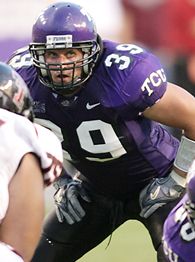

 Special Teams Player of the Year: Brian Bonner--this senior not only had the team's third-highest tackle total, but for the second year in a row, Brian Bonner was the MWC's most dangerous punt returner. He captained the defense, and dominated special teams.
 Outstanding Freshman: Andy Dalton--Dalton proved durable, capable, and when his backfield performed adequately, spectacular. The freshman showed his feet in the second half of the season.
Most Excited to See in '08: Jimmy Young, Stephen Hodge, Robert Henson, Daryl Washington
Photos: Keith Robinson
TCU 20, Houston 13
 In a microcosm for the season, TCU edged Houston at the 2007 Texas Bowl, despite injuries in the backfield. Starting tailback Aaron Brown did not play; bruiser Joe Turner left the game in the first half with an ankle injury.
Seniors Ervin Dickerson, Brian Bonner, and Chase Ortiz gave stand-out performances. Andy Dalton showed flashes both of brilliance and of inexperience, at times eluding and at other times succombing to a tough pass rush.
 The Frogs gave back two touchdowns because of penalties, and nearly had to test their mettle in overtime, after allowing Houston to drive nearly the whole field in the final minutes.
Chase Ortiz closed the book on the season, however, sacking the Cougars' quarterback and securing the Frogs' third straight post-season victory.
Photos: Keith Robinson
Thursday, December 13, 2007
Football at TCU
[this summary (minus more recent material) of TCU's football history was originally posted at The Thwarth's Wimple on September 20, 2006. The Wimple heartily recommends Caroline Collier's feature The Frogs Rise Again, published in the Fort Worth Weekly, November 24, 2009.]
Beginnings
TCU traces its football origins to 1896, when it was still AddRan College in Waco, Texas. The school played its cross-town rival, Baylor, twice a year.

After moving to Fort Worth, rivaling SMU in the new Southwest Conference, TCU football flourished. In the first 37 years TCU was a member of the SWC, from 1923 to 1960, the Horned Frogs were consistently the best team in the Southwest Conference. They won more national championships, conference championships, went to more bowl games, produced more all-Americans, the Conference’s first Heisman Trophy winner; became the first SWC school to play in the Sugar Bowl, Cotton Bowl, Orange Bowl and Bluebonnet Bowl, and maintained a winning edge over all six of their conference opponents. Read Dan Jenkins' colorful reminisce of that period here.
In 1994 the parting blow came: the Southwest Conference was dissolved when the Big Eight invited four SWC teams to join: Texas, A&M, Texas Tech and most bitterly, Baylor. Governor Ann Richards had pushed hard for her alma mater's inclusion in the expanded conference, and TCU was left with Houston, Rice and SMU to glean for themselves.
Conference Hopping
TCU's administration decided to begin an experiment: can a rule-abiding, student-graduating football program win in Divison I? The school began updating its athletic facilities. Pat Sullivan led the team through it's first years in a new conference, the WAC, including its darkest year, 1997, when its only win was against fellow wanderer SMU, keeping the Mustangs from bowl eligibility. Horned Frog students pulled down the goalposts, so glad were they for that win.
The next year Dennis Franchione was hired at great expense to turn around the program, which had again drawn the short straw, as the conference's top teams announced that they would withdraw in 1999 to form the Mountain West Conference. Perhaps the Horned Frogs had the last laugh, when they managed bowl eligibility in '98, and won an invite to the Sun Bowl. The bowl had a tie to the new Mountain West conference, but snubbed the clique, inviting the Fort Worth left-behinds instead. TCU outclassed USC in a memorable upset.
In 1999 a fullback named LaDainian Tomlinson that Franchione inherited from his predecessor was moved to tailback, and led the NCAA in rushing yards. In 2000, LT and defensive genius Gary Patterson led the Horned Frogs on a dizzying winning streak to the last game of the season, in San Jose. Following the Frogs to the west coast was a glut of media speculation about a bid for the Fiesta Bowl. In a rainy game, TCU lost inexplicably. A few weeks later, Franchione fled for a top-tier coaching post. ConferenceUSA invited the Frogs, who accepted and turned their attention east in conference play, for the first time.
The Patterson Era
In 2001, the team landed their fourth straight bowl game. The Frogs' quarterback threw the game away, being disgruntled at the coaches and having already decided to transfer to a D-2 team. In 2002 a bizarre trend began at TCU, when the starting quarterback got injured and his replacement seemed to be a better player. In this manner Sean Stilley gave way to Tye Gunn, who gave way to Brandon Hassell in 2003. Gunn's season ending injury in 2005 opened the door to Jeff Ballard, one of the winningest quarterbacks in TCU history.
 The 2003 season was similar to the 2000 season: a long winning streak coaxed great attention from the national media; the Fiesta Bowl took interest in TCU: so much that after the Frogs beat conference contender Louisville, the bowl put a little bag of Tostitos on every seat in Amon Carter Stadium for the next game. More than 40,000 fans attended the game, in which the Frogs routed Cincinnati. Expectations soared-- only road games to Southern Miss and SMU stood in the way of a BCS bowl, the jackpot of college football's bowl system. TCU played very poorly in Hattiesburg, but scored 28 points in less than 5 minutes in the 4th quarter to come within three points of a tie, but lost the game anyway. They returned to Texas and almost lost at SMU, and then lost the inaugural Fort Worth Bowl to Boise State a month later.
The experiment seemed to have reached its logical limits: a team outside the BCS cartel and resources, committed to recruiting and graduating honest student athletes, could win most games, but not regularly, and not under pressure.
This pattern was repeated in 2004 with a highly touted trip to Lubbock to face an old SWC foe, Texas Tech. Mike Leach had helped coach the BYU resurrection of Dutch Meyer's spread attack, and then implemented it in Lubbock with tremendous results. The Frogs held the Red Raiders scoreless for 25 minutes. By halftime, however, Mike Leach's offensive machine had come alive, and tied the score 21-21. The Frogs never regained momentum and left Lubbock with the most embarassing loss in recent memory, 70-35. The 5-6 season ended TCU's streak of bowl seasons at six. Head Coach Gary Patterson had the team drug tested in search for answers, so desparate was he to locate problems and get his team's attention.
Meanwhile, Utah achieved a BCS berth from the second tier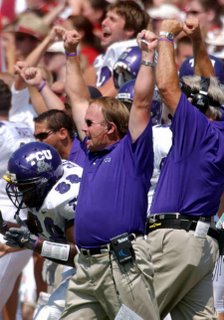 Mountain West conference- decimating Pittsburgh in the Fiesta Bowl. ConferenceUSA was gutted in a flurry of re-alignments; Louisville, South Florida and Cincinnati joined the Big East, a cartel conference, again leaving TCU behind. TCU joined the Mountain West that summer.
After a tremendous upset of 5th ranked Oklahoma to begin 2005, the Horned Frogs found their focus only after being upset the next week by 90-something ranked SMU. However, as Jeff Ballard replaced Tye Gunn to lead a stunning comeback win in Provo, the unlikely Frogs proceeded to sweep the conference, winning their first outright conference title since the 1950s, and landed a bowl bid against a Big 12 opponent in Houston, beating Iowa State 27-24.
The Frogs won and finished the season ranked 11 and 9 in the AP and Coaches polls. Coach Patterson turned down a top-tier coaching post in the Big 12, signaling that his optimistic statements about TCU contending for a BCS bowl and national title were more than coach-speak.

During the off season, the BCS cartel relaxed the admission rules for the lucrative BCS bowls. The Frogs began 2006 as the most prominent non-cartel contenders for a top-tier bowl, cementing that status with a defensive masterpiece against Texas Tech, holding the normally explosive Red Raiders to just one field goal. The Frogs didn't find their own offense until two conference losses had accumulated, tumbling out of the rankings and the national media attention once again. Jeff Ballard led the team to second place in the conference by the end of the season, cracking the top 25 in December, and decimating NIU in the Poinsettia Bowl with a suffocating, second-ranked defense. Meanwhile, the WAC champion Boise State followed Utah's lead to the Fiesta Bowl.
The 2007 season seemed custom-made for showcasing TCU's resurgent program. However, days before the season began, the defensive line turned into a work in progress, with Tommy Blake and James Vess absent; injuries decimated the backfield. Turnovers plagued the offense, and after an emotional loss in Austin, the Frogs went on to lose 4 conference games-- Air Force, Wyoming, Utah, and BYU, by a total of 18 points, but win a bowl berth, and the bowl, too. The program had reached the point where a bad season no longer meant a bowl-less one.
 In 2008, the MWC became increasing visible, as DirecTV began carrying its network, the mtn. TCU's defense returned to high form (#1 nationally), and the Frogs snuck up on BYU, handing the Cougars their first conference loss in over two years. The Frogs came within a missed field goal of the conference championship and an invitation to the Sugar Bowl.
Breakthrough
The Horned Frogs finally found the heretofore elusive mix in 2009, when they replaced offensive coordinators (sending Mike Schultz to Illinois, where Schultz efficiently sunk that offense, lasting only one year) and suddenly found themselves well-balanced, even in big games. Yes, there had been a talent upgrade in the works, but the Frogs returned much of its offense for the '09 season, and with the new coordinators and an influential new receivers coach (Rusty Burns), the offense simply went ballistic. TCU improved from the 21st best scoring offense and 24th best total offense in 2008 to 5th and 7th best, respectively. And this while fielding the nation's best defense, again led by two-time All-American defensive end Jerry Hughes. Dalton's connection with his wideouts suddenly weaponized. (Dalton's passer rating jumped from 129 in 2008 to 151, not least because of Antoine Hicks's knack for finding the endzone on long receptions.) Joe Turner, Matt Tucker, and Ed Wesley ran all over the competition-- and when they were given the reigns to do so, the Frogs were unstoppable. TCU notably won in the rain at Clemson, and in finger-freezing cold at Air Force, and then trod all the heck over BYU in Provo, Utah in Fort Worth, and everybody else in between. ESPN Gameday was on hand for the wins against BYU and Utah, the second of which came before the all-time biggest crowd at TCU. By year's end, the Frogs had outgained their conference opponents by 261 yards, on average.
Beginnings
TCU traces its football origins to 1896, when it was still AddRan College in Waco, Texas. The school played its cross-town rival, Baylor, twice a year.

After moving to Fort Worth, rivaling SMU in the new Southwest Conference, TCU football flourished. In the first 37 years TCU was a member of the SWC, from 1923 to 1960, the Horned Frogs were consistently the best team in the Southwest Conference. They won more national championships, conference championships, went to more bowl games, produced more all-Americans, the Conference’s first Heisman Trophy winner; became the first SWC school to play in the
 Sugar Bowl, Cotton Bowl, Orange Bowl and Bluebonnet Bowl, and maintained a winning edge over all six of their conference opponents. Read Dan Jenkins' colorful reminisce of that period here.
The Decade of Legends

In 1935, TCU and SMU battled for a bid to the Rose Bowl, in the "Game of the Century" (see Time Magazine's report of that game). Quarterback Sam Baugh (who came to TCU to play baseball, but was convinced by Coach Dutch Meyer to play football instead) led Meyer's revolutionary "spread" attack of short passes on any down first in college and then in the pros, leading the Horned Frogs and then Washington Redskins each to their first national titles. (Here's the TCU Magazine's posthumous feature on Baugh.) Baugh's successor Davey O'Brien took TCU to its second title, and won the Heisman, Maxwell and Walter Camp trophies for his unbeaten 1938 campaign. 

The 1950s Resurgence
The spread offense went out of style, but the Horned Frogs flourished again in the 1950s under Abe Martin, playing in the Cotton Bowl four times, including a win over Jim Brown and Syracuse in 1957. Jim Swink led the squad in the late '50s. (This SI.com writeup about the '57 season, and the pre-game photo at the right, which Sports Illustrated named its photo of the century for the 1900s, is spectacular.) TCU expanded the football stadium, nearly doubling its seating capacity, and adding the distinctive upper deck that still dominates the southwest Fort Worth landscape.
Complacency and Decline
 After the 1959 Cotton Bowl, TCU let the Southwest Conference pass it by in recruiting, facilities, and budgeting. The decade was not without its bright spots-- TCU upset Texas a number of times, once thwarting the state school's bid for a national title. Darrell Royal, the Longhorn coach, fought back off the field, pressing for--and getting-- rule changes that allowed for unlimited substitutions during the game. This gave rise to two-squad play, where teams field separate offensive and defensive
 units. As predicted, state schools flourished in the new game, as their superior funding and attractiveness with the GI Bill enabled them to gather in the best recruits, sometimes offering a good player a scholarship just so he wouldn't play on another team. Until 1994 there was no limit to the number of athletic scholarships a school could maintain, giving a distinct edge to the state-funded schools.
 For TCU, which didn't evolve with the the game very well, the result was three long decades of football mediocrity: from 1960 to 1998, TCU appeared on the AP poll only six times-- four of these in '84.
The SWC schools engaged in flagrant cheating in competition for high school recruits. In the late 1970s, TCU boosters joined in, financing top-price recruits and a conference co-champ team by '84. (OU's coach Barry Switzer indicated surprise when his team lost to little TCU in a bidding war for a recruit!) Coach Jim Wacker caught wind of the violations, and gave an impassioned speech to the team, urging them to come clean and stay that way. Kenneth Davis, a Heisman finalist and All-American runningback, and several other players confessed taking money from boosters. The NCAA imposed the "death penalty" on the school, cancelling TV revenue, scholarships, and post-season eligibility. Losses mounted; SMU had already been penalized, and soon found itself the first (and to date, last) NCAA program to suffer the "death penalty." Oddly, other SWC schools, notably Texas A&M, received only light sanctions for similar infractions.
The spread offense went out of style, but the Horned Frogs flourished again in the 1950s under Abe Martin, playing in the Cotton Bowl four times, including a win over Jim Brown and Syracuse in 1957. Jim Swink led the squad in the late '50s. (This SI.com writeup about the '57 season, and the pre-game photo at the right, which Sports Illustrated named its photo of the century for the 1900s, is spectacular.) TCU expanded the football stadium, nearly doubling its seating capacity, and adding the distinctive upper deck that still dominates the southwest Fort Worth landscape.
Complacency and Decline
 After the 1959 Cotton Bowl, TCU let the Southwest Conference pass it by in recruiting, facilities, and budgeting. The decade was not without its bright spots-- TCU upset Texas a number of times, once thwarting the state school's bid for a national title. Darrell Royal, the Longhorn coach, fought back off the field, pressing for--and getting-- rule changes that allowed for unlimited substitutions during the game. This gave rise to two-squad play, where teams field separate offensive and defensive
 units. As predicted, state schools flourished in the new game, as their superior funding and attractiveness with the GI Bill enabled them to gather in the best recruits, sometimes offering a good player a scholarship just so he wouldn't play on another team. Until 1994 there was no limit to the number of athletic scholarships a school could maintain, giving a distinct edge to the state-funded schools.
 For TCU, which didn't evolve with the the game very well, the result was three long decades of football mediocrity: from 1960 to 1998, TCU appeared on the AP poll only six times-- four of these in '84.
The SWC schools engaged in flagrant cheating in competition for high school recruits. In the late 1970s, TCU boosters joined in, financing top-price recruits and a conference co-champ team by '84. (OU's coach Barry Switzer indicated surprise when his team lost to little TCU in a bidding war for a recruit!) Coach Jim Wacker caught wind of the violations, and gave an impassioned speech to the team, urging them to come clean and stay that way. Kenneth Davis, a Heisman finalist and All-American runningback, and several other players confessed taking money from boosters.
 The NCAA imposed the "death penalty" on the school, cancelling TV revenue, scholarships, and post-season eligibility. Losses mounted; SMU had already been penalized, and soon found itself the first (and to date, last) NCAA program to suffer the "death penalty." Oddly, other SWC schools, notably Texas A&M, received only light sanctions for similar infractions.
 In 1994 the parting blow came: the Southwest Conference was dissolved when the Big Eight invited four SWC teams to join: Texas, A&M, Texas Tech and most bitterly, Baylor. Governor Ann Richards had pushed hard for her alma mater's inclusion in the expanded conference, and TCU was left with Houston, Rice and SMU to glean for themselves.
Conference Hopping
TCU's administration decided to begin an experiment: can a rule-abiding, student-graduating football program win in Divison I? The school began updating its athletic facilities. Pat Sullivan led the team through it's first years in a new conference, the WAC, including its darkest year, 1997, when its only win was against fellow wanderer SMU, keeping the Mustangs from bowl eligibility. Horned Frog students pulled down the goalposts, so glad were they for that win.
The
 next year Dennis Franchione was hired at great expense to turn around the program, which had again drawn the short straw, as the conference's top teams announced that they would withdraw in 1999 to form the Mountain West Conference. Perhaps the Horned Frogs had the last laugh, when they managed bowl eligibility in '98, and won an invite to the Sun Bowl. The bowl had a tie to the new Mountain West conference, but snubbed the clique, inviting the Fort Worth left-behinds instead. TCU outclassed USC in a memorable upset.
In 1999 a fullback named LaDainian Tomlinson that Franchione inherited from his predecessor was moved to tailback, and led the NCAA in rushing yards. In 2000, LT and defensive genius Gary Patterson led the Horned Frogs on a dizzying winning streak
 to the last game of the season, in San Jose. Following the Frogs to the west coast was a glut of media speculation about a bid for the Fiesta Bowl. In a rainy game, TCU lost inexplicably. A few weeks later, Franchione fled for a top-tier coaching post. ConferenceUSA invited the Frogs, who accepted and turned their attention east in conference play, for the first time.
The Patterson Era
In 2001, the team landed their fourth straight bowl game. The Frogs' quarterback threw the game away, being disgruntled at the coaches and having already decided to transfer to a D-2 team. In 2002 a bizarre trend began at TCU, when the starting quarterback got injured and his replacement seemed to be a better player. In this manner Sean Stilley gave way to Tye Gunn, who gave way to Brandon Hassell in 2003. Gunn's season ending injury in 2005 opened the door to Jeff Ballard, one of the winningest quarterbacks in TCU history.
 The 2003 season was similar to the 2000 season: a long winning streak coaxed great attention from the national media; the Fiesta Bowl took interest in TCU: so much that after the Frogs beat conference contender Louisville, the bowl put a little bag of Tostitos on every seat in Amon Carter Stadium for the next game. More than 40,000 fans attended the game, in which the Frogs routed Cincinnati. Expectations soared-- only road games to Southern Miss and SMU stood in the way of a BCS bowl, the jackpot of college football's bowl system. TCU played very poorly in Hattiesburg, but scored 28 points in less than 5 minutes in the 4th quarter to come within three points of a tie, but lost the game anyway. They returned to Texas and almost lost at SMU, and then lost the inaugural Fort Worth Bowl to Boise State a month later.
The experiment seemed to have reached its logical limits: a team outside
 the BCS cartel and resources, committed to recruiting and graduating honest student athletes, could win most games, but not regularly, and not under pressure.
This pattern was repeated in 2004 with a highly touted trip to Lubbock to face an old SWC foe, Texas Tech. Mike Leach had helped coach the BYU resurrection of Dutch Meyer's spread attack, and then implemented it in Lubbock with tremendous results. The Frogs held the Red Raiders scoreless for 25 minutes. By halftime, however, Mike Leach's offensive machine had come alive, and tied the score 21-21. The Frogs never regained momentum and left Lubbock with the most embarassing loss in recent memory, 70-35. The 5-6 season ended TCU's streak of bowl seasons at six. Head Coach Gary Patterson had the team drug tested in search for answers, so desparate was he to locate problems and get his team's attention.
Meanwhile, Utah achieved a BCS berth from the second tier
 Mountain West conference- decimating Pittsburgh in the Fiesta Bowl. ConferenceUSA was gutted in a flurry of re-alignments; Louisville, South Florida and Cincinnati joined the Big East, a cartel conference, again leaving TCU behind. TCU joined the Mountain West that summer.
After a tremendous upset of 5th ranked Oklahoma to begin 2005, the Horned Frogs found their focus only after being upset the next week by 90-something ranked SMU. However, as Jeff Ballard replaced Tye Gunn to lead a stunning comeback
 win in Provo, the unlikely Frogs proceeded to sweep the conference, winning their first outright conference title since the 1950s, and landed a bowl bid against a Big 12 opponent in Houston, beating Iowa State 27-24.
 The Frogs won and finished the season ranked 11 and 9 in the AP and Coaches polls. Coach Patterson turned down a top-tier coaching post in the Big 12, signaling that his optimistic statements about TCU contending for a BCS bowl and national title were more than coach-speak.

During the off season, the BCS cartel relaxed the admission rules for the lucrative BCS bowls. The Frogs began 2006 as the most prominent non-cartel contenders for a top-tier bowl, cementing that status with a defensive masterpiece against Texas Tech, holding the normally explosive Red Raiders to just one field goal. The Frogs didn't find their own offense until two conference losses had accumulated, tumbling out of the rankings and the national media attention once again.
 Jeff Ballard led the team to second place in the conference by the end of the season, cracking the top 25 in December, and decimating NIU in the Poinsettia Bowl with a suffocating, second-ranked defense. Meanwhile, the WAC champion Boise State followed Utah's lead to the Fiesta Bowl.
 The 2007 season seemed custom-made for showcasing TCU's resurgent program. However, days before the season began, the defensive line turned into a work in progress, with Tommy Blake and James Vess absent; injuries decimated the backfield. Turnovers plagued the offense, and after an emotional loss in Austin, the Frogs went on to lose 4 conference games-- Air Force, Wyoming, Utah, and BYU, by a total of 18 points, but win a bowl berth, and the bowl, too. The program had reached the point where a bad season no longer meant a bowl-less one.
 In 2008, the MWC became increasing visible, as DirecTV began carrying its network, the mtn. TCU's defense returned to high form (#1 nationally), and the Frogs snuck up on BYU, handing the Cougars their first conference loss in over two years. The Frogs came within a missed field goal of the conference championship and an invitation to the Sugar Bowl.
Breakthrough
The Horned Frogs finally found the heretofore elusive mix in 2009, when they replaced offensive coordinators (sending Mike Schultz to Illinois, where Schultz efficiently sunk that offense, lasting only one year) and suddenly found themselves well-balanced, even in big games. Yes, there had been a talent upgrade in the works, but the Frogs returned much of its offense for the '09 season, and with the new coordinators and an influential new receivers coach (Rusty Burns), the offense simply went ballistic. TCU improved from the 21st best scoring offense and 24th best total offense in 2008 to 5th and 7th best, respectively. And this while fielding the nation's best defense, again led by two-time All-American defensive end Jerry Hughes.
 Dalton's connection with his wideouts suddenly weaponized. (Dalton's passer rating jumped from 129 in 2008 to 151, not least because of Antoine Hicks's knack for finding the endzone on long receptions.) Joe Turner, Matt Tucker, and Ed Wesley ran all over the competition-- and when they were given the reigns to do so, the Frogs were unstoppable. TCU notably won in the rain at Clemson, and in finger-freezing cold at Air Force, and then trod all the heck over BYU in Provo, Utah in Fort Worth, and everybody else in between. ESPN Gameday was on hand for the wins against BYU and Utah, the second of which came before the all-time biggest crowd at TCU. By year's end, the Frogs had outgained their conference opponents by 261 yards, on average.
 The only blemish: the culminating game of the season was the Fiesta Bowl, against Boise State, another non-cartel team. The Frogs went into that historic matchup feeling like they had been robbed of a chance to best a BCS legacy program, and in the end left losers. Maddengly, the Frogs chose not to try and run the ball in the face of an unexpected realigned Boise defense. Shorn of its balance, the Frog offense sputtered, and TCU lost the defensive battle, 17-10.
 TCU's loss in Glendale lowered its national rank to #6-- which was higher than earlier years' teams would have dreamed of finishing. Remarkably, the Frogs will start 2010 ranked about the same-- 6-- and won't be the highest ranked non-cartel team. Boise will start at #2 or #3. Replacing only one starter, really, on offense (left tackle Marshall Newhouse), the Frogs should field their most explosive offense, ever. The defense, while replacing Jerry Hughes, Daryl Washington, and two four-year starters at CB (Nick Sanders and Raphael Priest), shouldn't fall too far from its accustomed #1 national ranking.
So the experiment has changed: yes, a clean-run non-cartel program can break into the big-money bowls; can it sustain that kind of success into a realistic run at the biggest bowl of them all? Given their returning experience, talent, and starting position, 2010 will be the Frogs' best chance.
 TCU's loss in Glendale lowered its national rank to #6-- which was higher than earlier years' teams would have dreamed of finishing. Remarkably, the Frogs will start 2010 ranked about the same-- 6-- and won't be the highest ranked non-cartel team. Boise will start at #2 or #3. Replacing only one starter, really, on offense (left tackle Marshall Newhouse), the Frogs should field their most explosive offense, ever. The defense, while replacing Jerry Hughes, Daryl Washington, and two four-year starters at CB (Nick Sanders and Raphael Priest), shouldn't fall too far from its accustomed #1 national ranking.
So the experiment has changed: yes, a clean-run non-cartel program can break into the big-money bowls; can it sustain that kind of success into a realistic run at the biggest bowl of them all? Given their returning experience, talent, and starting position, 2010 will be the Frogs' best chance.
[photos: (top to bottom) TCU Stadium in the 1940s, Davey O'Brien, Sam Baugh, TCU at halftime during the 1957 Cotton-Bowl, Jim Swink, Bob Lilly in the NFL, TCU beats Texas in the 1960s, TCU v. Texas in 1994, Basil Mitchell runs past USC at the 1998 Sun Bowl, LT runs for 406 yards against UTEP, TCU v. Cincinnati in 2003, Texas Tech v. TCU in 2004, Cory Rodgers returns a kickoff for a touchdown at BYU in 2005, Coach Patterson celebrates TCU's victory over OU in Norman in 2005, TCU v. Texas Tech in 2006, Jeff Ballard scores against NIU in 2006, Antoine Hicks scores, 2009, Matthew Tucker's one (!$#%$^!) touch during the Fiesta Bowl, 2010, Andy Dalton at the Fiesta Bowl, 2009.]
Friday, December 7, 2007
Post-season awards
 Several TCU football players have received recognition in the post season.
Chase Ortiz and Brian Bonner made the MWC First-Team;
Jason Phillips, Blake Schleuter, Stephen Hodge, and David Roach made the Second Team;
Robert Henson, Marshall Newhouse, Chris Manfredini, Rafael Priest, and Derek Wash received honorable mentions.
Chase Ortiz will play in the East-West Shrine all-star game. Andy Dalton and Kelly Griffin received an honorable mention on the Sporting News' freshman All-American team.
Phil Steele put 13 Frogs on his All-MWC team.
Thursday, December 6, 2007
The American Enterprise Institute dumps on the BCS
Normally AEI's online magazine, The American, gets the Wimple's attention at The Thwarth's Wimple. But today The American has an article up about the BCS and how inferior it is to a playoff, and how the usual litany of defenses for the BCS cartel are insufficient.
Link to the article through the title of this post.
Link to the article through the title of this post.
Monday, December 3, 2007
TCU to return to Houston for the Texas Bowl; 5 MWC Teams Go Bowling
 http://www.texasbowl.org/-- TCU will square off against the Houston Cougars in the 2007 Texas Bowl . . . This is the Horned Frogs’ third consecutive winning season and their third consecutive bowl appearance. . . TCU head coach Gary Patterson is in his seventh season at the helm and has posted a 60-25 record, including leading the Horned Frogs to a bowl game six times. Patterson has had four 10-win seasons, more then any other coach in TCU history.
The 2007 Texas Bowl will be played on Friday, December 28 at Reliant Stadium at 7:00 p.m. and the game will be televised nationally on NFL Network. DePelchin Children’s Center, Houston’s oldest charitable organization, is the official charitable partner of the Texas Bowl.
[here's the goFrogs.com release]
Five Mountain West teams will play bowl games this year- the most ever. The Mtn.'s preview of the MWC bowls.
BYU will face UCLA (again!) in Las Vegas, Air Force v. California in Fort Worth; Utah v. Navy in San Diego, TCU v. Houston in Houston, and New Mexico v. Nevada in Albequerque.
Subscribe to:
Posts (Atom)


