Showing posts with label Football History. Show all posts
Showing posts with label Football History. Show all posts
Friday, December 18, 2009
Repeat All-American
In honor of Jerry Hughes' second consecutive season as a consensus (at least!) first-team All-American, comes this trivia question: Who was the last Horned Frog to repeat as a first-team All-American?

Monday, November 23, 2009
Not just another day in Frog heaven
When TCU takes the field Saturday, it will be well favored to beat New Mexico; to finish the regular season 12-0, giving this year's seniors the most wins of any class of Horned Frogs in history; to clinch a berth to its biggest bowl game since the '50s; and to take an honored place among the great teams of the 1930s that achieved this singular distinction: unbeaten in the regular season. All of that is grand, and worthy of much fanfare; but the Wimple offers another perspective on TCU's remarkable 2009 campaign.
When the Southwest Conference broke up in 1994, leaving TCU and three other weaklings to rot, its abandonment of the Horned Frogs was particularly poignant. Oldtimers well remembered when TCU was the giant among Texas schools during the Depression; not-so-old timers could recall TCU's decade-long duel in the '50s with UT for conference supremacy. But for a generation after TCU surrendered that war, letting two-squad play, limitless scholarships for state schools under the GI Bill, and rampant cheating in paying for recruits, all pass it by, the Horned Frogs were a bland and brand-less squad, losers on the gridiron. Its boosters succumbed to the "way it was" in the early '80s, paying their way to the conference championship in '84, before the hammer fell.
Several years ago, the Wimple recounted all of this in greater detail; this tale of decline reaches bottom with the "walking death penalty" given TCU in '85, and its conference's demise a decade later. Then came the revival-- labeled an "experiment" in that larger telling. Could a rule-abiding, privately-funded non-cartel football team thrive in Division 1-A ? Early returns were hopeful, but the program seemed unable to put the cap on its upswings. Dizzying flirtations with BCS bids ended unfruitfully in 2000 and 2003 with late-season road losses scaring off the cartel suitor-agents. An early-season loss in '05 kept them away until it was too late; another late-season road loss was excuse enough in '08, despite laxer eligibility rules that kept TCU technically (but not practically) in play through selection Sunday. The Wimple's history concluded:
What changed?
Dr. Saturday gives a hint:
Several changes among the coordinators may have prompted the outburst on the field. Rusty Burns has taught the receivers how to upgrade their blocking and route running. First-year playcallers Justin Fuente and Jarrett Anderson have opened the playbook a little. But the Frogs have amassed a frightful cast of weapons for these coaches to deploy in any formation. The talent upgrade that has been underway since about 2005 has begun to show up between the hashmarks. Every indication points to a further rise in the Frogs' on-field prowess.
Given a win Saturday, it will be time to re-cast the narrative of football in purple and white. Beating New Mexico will complete the Revival, and more than merely a new chapter in the history of TCU football: it will commence a new book entirely. That tome's title?
Juggernaut.
When the Southwest Conference broke up in 1994, leaving TCU and three other weaklings to rot, its abandonment of the Horned Frogs was particularly poignant. Oldtimers well remembered when TCU was the giant among Texas schools during the Depression; not-so-old timers could recall TCU's decade-long duel in the '50s with UT for conference supremacy. But for a generation after TCU surrendered that war, letting two-squad play, limitless scholarships for state schools under the GI Bill, and rampant cheating in paying for recruits, all pass it by, the Horned Frogs were a bland and brand-less squad, losers on the gridiron. Its boosters succumbed to the "way it was" in the early '80s, paying their way to the conference championship in '84, before the hammer fell.
Several years ago, the Wimple recounted all of this in greater detail; this tale of decline reaches bottom with the "walking death penalty" given TCU in '85, and its conference's demise a decade later. Then came the revival-- labeled an "experiment" in that larger telling. Could a rule-abiding, privately-funded non-cartel football team thrive in Division 1-A ? Early returns were hopeful, but the program seemed unable to put the cap on its upswings. Dizzying flirtations with BCS bids ended unfruitfully in 2000 and 2003 with late-season road losses scaring off the cartel suitor-agents. An early-season loss in '05 kept them away until it was too late; another late-season road loss was excuse enough in '08, despite laxer eligibility rules that kept TCU technically (but not practically) in play through selection Sunday. The Wimple's history concluded:
The experiment seemed to have reached its logical limits: a team outside the BCS cartel and resources, committed to recruiting and graduating honest student athletes, could win most games, but not regularly, and not under pressure.Indeed, TCU appeared good enough to flirt with the big-money bowls, high poll ranking, and NFL-bound talent. But fate never seemed to bless the Frogs' attempts to assemble all of the ingredients. But a TCU victory Saturday will render that sentence incomplete without the following caveat: until 2009. What the Frogs may accomplish in five days is no less than a reversal of almost 50 years' curse. TCU may rise above irrelevance on Saturday; above its nomad journey through the outcasts of Division 1-A; above a couple generations' acceptance as a has-been, a history lesson, a glint only in grandfathers' eyes. TCU again vies with Texas for supremacy in the Lone Star State, and in the nation.
What changed?
Dr. Saturday gives a hint:
"TCU ... is good at everything -- literally everything. The Frogs currently rank in the top 10 nationally in pretty much every conceivable facet of the game: Scoring Offense (No. 5), Total Offense (5), Scoring Defense (6), Total Defense (4), Rushing Offense (5), Pass Efficiency Offense (9), Rushing Defense (6), Passing Defense (3), Pass Efficiency Defense (5), First Downs Gained (7), First Downs Allowed (1), Third Down Defense, Kickoff Returns (1), Sacks Allowed (6), [and] Time of Possession (10)."There's no doubt the '09 Frogs have added potent offense and special teams play to their portfolio, which has including nationally leading defense frequently since Gary Patterson's arrival in 1998. But the addition of (and better use of) top-talent on offense appears to have been the missing piece. With its new mojo holding the ball, TCU went to Clemson, Air Force, and BYU, and beat all three. In its last six games TCU has averaged over 523 yards per game, 300 of those on the ground. And all of this without a single 1,000-yard rusher or receiver!
Several changes among the coordinators may have prompted the outburst on the field. Rusty Burns has taught the receivers how to upgrade their blocking and route running. First-year playcallers Justin Fuente and Jarrett Anderson have opened the playbook a little. But the Frogs have amassed a frightful cast of weapons for these coaches to deploy in any formation. The talent upgrade that has been underway since about 2005 has begun to show up between the hashmarks. Every indication points to a further rise in the Frogs' on-field prowess.
Given a win Saturday, it will be time to re-cast the narrative of football in purple and white. Beating New Mexico will complete the Revival, and more than merely a new chapter in the history of TCU football: it will commence a new book entirely. That tome's title?
Juggernaut.
Monday, November 16, 2009
25 years ago...
... SMU and TCU both went to bowl games in the same season: TCU to the Independence Bowl, and SMU to the Aloha Bowl. Prior to '84, both teams bowled in the same season just twice. In 1948, both teams played January first bowls: TCU in the first Delta Bowl and SMU in the Cotton. The first time TCU and SMU bowled in the same year was after the famous 1935 Game of the Century, when SMU beat Sam Baugh and TCU, winning a bid to the Rose Bowl, and TCU settled for a Sugar Bowl berth.
When'll be the fourth time these stars align? 2009 (including early 2010, if the Frogs win out). SMU joined TCU in bowl eligibility with its come from behind win over UTEP Saturday.
When'll be the fourth time these stars align? 2009 (including early 2010, if the Frogs win out). SMU joined TCU in bowl eligibility with its come from behind win over UTEP Saturday.
Wednesday, December 17, 2008
Sam Baugh, 1914-2008
 Lower the team flags; fly the championship standards at half-mast; the Wimple will be draped for mourning until the Frogs win their next game. TCU's- and football's- first great passer has crossed the plane of that great endzone in the sky. Baugh was the last living member of the inaugural Pro Football Hall of Fame, and a member of the college hall of fame as well. As the FWST aptly puts it, he was the original cowboy quarterback. He was 94.
Here're clips of a interview with Baugh when he was already an old man, with footage from his NFL days; see him passing as a Washington Redskin.
The Deseret News ran a great editorial about Baugh prior to the Frogs' '06 clash with BYU. Ray Buck, Jeff Wilson, Kevin Sherrington; Washington Post; ESPN's Luksa; Baugh timeline; LATimes; AP; ESPN story, and interviews Mike Ditka (in video), Dr. Saturday; Dick Heller.
Monday, March 31, 2008
Thursday, December 13, 2007
Football at TCU
[this summary (minus more recent material) of TCU's football history was originally posted at The Thwarth's Wimple on September 20, 2006. The Wimple heartily recommends Caroline Collier's feature The Frogs Rise Again, published in the Fort Worth Weekly, November 24, 2009.]
Beginnings
TCU traces its football origins to 1896, when it was still AddRan College in Waco, Texas. The school played its cross-town rival, Baylor, twice a year.

After moving to Fort Worth, rivaling SMU in the new Southwest Conference, TCU football flourished. In the first 37 years TCU was a member of the SWC, from 1923 to 1960, the Horned Frogs were consistently the best team in the Southwest Conference. They won more national championships, conference championships, went to more bowl games, produced more all-Americans, the Conference’s first Heisman Trophy winner; became the first SWC school to play in the Sugar Bowl, Cotton Bowl, Orange Bowl and Bluebonnet Bowl, and maintained a winning edge over all six of their conference opponents. Read Dan Jenkins' colorful reminisce of that period here.
In 1994 the parting blow came: the Southwest Conference was dissolved when the Big Eight invited four SWC teams to join: Texas, A&M, Texas Tech and most bitterly, Baylor. Governor Ann Richards had pushed hard for her alma mater's inclusion in the expanded conference, and TCU was left with Houston, Rice and SMU to glean for themselves.
Conference Hopping
TCU's administration decided to begin an experiment: can a rule-abiding, student-graduating football program win in Divison I? The school began updating its athletic facilities. Pat Sullivan led the team through it's first years in a new conference, the WAC, including its darkest year, 1997, when its only win was against fellow wanderer SMU, keeping the Mustangs from bowl eligibility. Horned Frog students pulled down the goalposts, so glad were they for that win.
The next year Dennis Franchione was hired at great expense to turn around the program, which had again drawn the short straw, as the conference's top teams announced that they would withdraw in 1999 to form the Mountain West Conference. Perhaps the Horned Frogs had the last laugh, when they managed bowl eligibility in '98, and won an invite to the Sun Bowl. The bowl had a tie to the new Mountain West conference, but snubbed the clique, inviting the Fort Worth left-behinds instead. TCU outclassed USC in a memorable upset.
In 1999 a fullback named LaDainian Tomlinson that Franchione inherited from his predecessor was moved to tailback, and led the NCAA in rushing yards. In 2000, LT and defensive genius Gary Patterson led the Horned Frogs on a dizzying winning streak to the last game of the season, in San Jose. Following the Frogs to the west coast was a glut of media speculation about a bid for the Fiesta Bowl. In a rainy game, TCU lost inexplicably. A few weeks later, Franchione fled for a top-tier coaching post. ConferenceUSA invited the Frogs, who accepted and turned their attention east in conference play, for the first time.
The Patterson Era
In 2001, the team landed their fourth straight bowl game. The Frogs' quarterback threw the game away, being disgruntled at the coaches and having already decided to transfer to a D-2 team. In 2002 a bizarre trend began at TCU, when the starting quarterback got injured and his replacement seemed to be a better player. In this manner Sean Stilley gave way to Tye Gunn, who gave way to Brandon Hassell in 2003. Gunn's season ending injury in 2005 opened the door to Jeff Ballard, one of the winningest quarterbacks in TCU history.
 The 2003 season was similar to the 2000 season: a long winning streak coaxed great attention from the national media; the Fiesta Bowl took interest in TCU: so much that after the Frogs beat conference contender Louisville, the bowl put a little bag of Tostitos on every seat in Amon Carter Stadium for the next game. More than 40,000 fans attended the game, in which the Frogs routed Cincinnati. Expectations soared-- only road games to Southern Miss and SMU stood in the way of a BCS bowl, the jackpot of college football's bowl system. TCU played very poorly in Hattiesburg, but scored 28 points in less than 5 minutes in the 4th quarter to come within three points of a tie, but lost the game anyway. They returned to Texas and almost lost at SMU, and then lost the inaugural Fort Worth Bowl to Boise State a month later.
The experiment seemed to have reached its logical limits: a team outside the BCS cartel and resources, committed to recruiting and graduating honest student athletes, could win most games, but not regularly, and not under pressure.
This pattern was repeated in 2004 with a highly touted trip to Lubbock to face an old SWC foe, Texas Tech. Mike Leach had helped coach the BYU resurrection of Dutch Meyer's spread attack, and then implemented it in Lubbock with tremendous results. The Frogs held the Red Raiders scoreless for 25 minutes. By halftime, however, Mike Leach's offensive machine had come alive, and tied the score 21-21. The Frogs never regained momentum and left Lubbock with the most embarassing loss in recent memory, 70-35. The 5-6 season ended TCU's streak of bowl seasons at six. Head Coach Gary Patterson had the team drug tested in search for answers, so desparate was he to locate problems and get his team's attention.
Meanwhile, Utah achieved a BCS berth from the second tier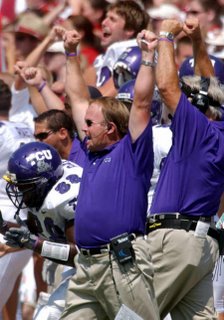 Mountain West conference- decimating Pittsburgh in the Fiesta Bowl. ConferenceUSA was gutted in a flurry of re-alignments; Louisville, South Florida and Cincinnati joined the Big East, a cartel conference, again leaving TCU behind. TCU joined the Mountain West that summer.
After a tremendous upset of 5th ranked Oklahoma to begin 2005, the Horned Frogs found their focus only after being upset the next week by 90-something ranked SMU. However, as Jeff Ballard replaced Tye Gunn to lead a stunning comeback win in Provo, the unlikely Frogs proceeded to sweep the conference, winning their first outright conference title since the 1950s, and landed a bowl bid against a Big 12 opponent in Houston, beating Iowa State 27-24.
The Frogs won and finished the season ranked 11 and 9 in the AP and Coaches polls. Coach Patterson turned down a top-tier coaching post in the Big 12, signaling that his optimistic statements about TCU contending for a BCS bowl and national title were more than coach-speak.

During the off season, the BCS cartel relaxed the admission rules for the lucrative BCS bowls. The Frogs began 2006 as the most prominent non-cartel contenders for a top-tier bowl, cementing that status with a defensive masterpiece against Texas Tech, holding the normally explosive Red Raiders to just one field goal. The Frogs didn't find their own offense until two conference losses had accumulated, tumbling out of the rankings and the national media attention once again. Jeff Ballard led the team to second place in the conference by the end of the season, cracking the top 25 in December, and decimating NIU in the Poinsettia Bowl with a suffocating, second-ranked defense. Meanwhile, the WAC champion Boise State followed Utah's lead to the Fiesta Bowl.
The 2007 season seemed custom-made for showcasing TCU's resurgent program. However, days before the season began, the defensive line turned into a work in progress, with Tommy Blake and James Vess absent; injuries decimated the backfield. Turnovers plagued the offense, and after an emotional loss in Austin, the Frogs went on to lose 4 conference games-- Air Force, Wyoming, Utah, and BYU, by a total of 18 points, but win a bowl berth, and the bowl, too. The program had reached the point where a bad season no longer meant a bowl-less one.
 In 2008, the MWC became increasing visible, as DirecTV began carrying its network, the mtn. TCU's defense returned to high form (#1 nationally), and the Frogs snuck up on BYU, handing the Cougars their first conference loss in over two years. The Frogs came within a missed field goal of the conference championship and an invitation to the Sugar Bowl.
Breakthrough
The Horned Frogs finally found the heretofore elusive mix in 2009, when they replaced offensive coordinators (sending Mike Schultz to Illinois, where Schultz efficiently sunk that offense, lasting only one year) and suddenly found themselves well-balanced, even in big games. Yes, there had been a talent upgrade in the works, but the Frogs returned much of its offense for the '09 season, and with the new coordinators and an influential new receivers coach (Rusty Burns), the offense simply went ballistic. TCU improved from the 21st best scoring offense and 24th best total offense in 2008 to 5th and 7th best, respectively. And this while fielding the nation's best defense, again led by two-time All-American defensive end Jerry Hughes. Dalton's connection with his wideouts suddenly weaponized. (Dalton's passer rating jumped from 129 in 2008 to 151, not least because of Antoine Hicks's knack for finding the endzone on long receptions.) Joe Turner, Matt Tucker, and Ed Wesley ran all over the competition-- and when they were given the reigns to do so, the Frogs were unstoppable. TCU notably won in the rain at Clemson, and in finger-freezing cold at Air Force, and then trod all the heck over BYU in Provo, Utah in Fort Worth, and everybody else in between. ESPN Gameday was on hand for the wins against BYU and Utah, the second of which came before the all-time biggest crowd at TCU. By year's end, the Frogs had outgained their conference opponents by 261 yards, on average.
Beginnings
TCU traces its football origins to 1896, when it was still AddRan College in Waco, Texas. The school played its cross-town rival, Baylor, twice a year.

After moving to Fort Worth, rivaling SMU in the new Southwest Conference, TCU football flourished. In the first 37 years TCU was a member of the SWC, from 1923 to 1960, the Horned Frogs were consistently the best team in the Southwest Conference. They won more national championships, conference championships, went to more bowl games, produced more all-Americans, the Conference’s first Heisman Trophy winner; became the first SWC school to play in the
 Sugar Bowl, Cotton Bowl, Orange Bowl and Bluebonnet Bowl, and maintained a winning edge over all six of their conference opponents. Read Dan Jenkins' colorful reminisce of that period here.
The Decade of Legends

In 1935, TCU and SMU battled for a bid to the Rose Bowl, in the "Game of the Century" (see Time Magazine's report of that game). Quarterback Sam Baugh (who came to TCU to play baseball, but was convinced by Coach Dutch Meyer to play football instead) led Meyer's revolutionary "spread" attack of short passes on any down first in college and then in the pros, leading the Horned Frogs and then Washington Redskins each to their first national titles. (Here's the TCU Magazine's posthumous feature on Baugh.) Baugh's successor Davey O'Brien took TCU to its second title, and won the Heisman, Maxwell and Walter Camp trophies for his unbeaten 1938 campaign. 

The 1950s Resurgence
The spread offense went out of style, but the Horned Frogs flourished again in the 1950s under Abe Martin, playing in the Cotton Bowl four times, including a win over Jim Brown and Syracuse in 1957. Jim Swink led the squad in the late '50s. (This SI.com writeup about the '57 season, and the pre-game photo at the right, which Sports Illustrated named its photo of the century for the 1900s, is spectacular.) TCU expanded the football stadium, nearly doubling its seating capacity, and adding the distinctive upper deck that still dominates the southwest Fort Worth landscape.
Complacency and Decline
 After the 1959 Cotton Bowl, TCU let the Southwest Conference pass it by in recruiting, facilities, and budgeting. The decade was not without its bright spots-- TCU upset Texas a number of times, once thwarting the state school's bid for a national title. Darrell Royal, the Longhorn coach, fought back off the field, pressing for--and getting-- rule changes that allowed for unlimited substitutions during the game. This gave rise to two-squad play, where teams field separate offensive and defensive
 units. As predicted, state schools flourished in the new game, as their superior funding and attractiveness with the GI Bill enabled them to gather in the best recruits, sometimes offering a good player a scholarship just so he wouldn't play on another team. Until 1994 there was no limit to the number of athletic scholarships a school could maintain, giving a distinct edge to the state-funded schools.
 For TCU, which didn't evolve with the the game very well, the result was three long decades of football mediocrity: from 1960 to 1998, TCU appeared on the AP poll only six times-- four of these in '84.
The SWC schools engaged in flagrant cheating in competition for high school recruits. In the late 1970s, TCU boosters joined in, financing top-price recruits and a conference co-champ team by '84. (OU's coach Barry Switzer indicated surprise when his team lost to little TCU in a bidding war for a recruit!) Coach Jim Wacker caught wind of the violations, and gave an impassioned speech to the team, urging them to come clean and stay that way. Kenneth Davis, a Heisman finalist and All-American runningback, and several other players confessed taking money from boosters. The NCAA imposed the "death penalty" on the school, cancelling TV revenue, scholarships, and post-season eligibility. Losses mounted; SMU had already been penalized, and soon found itself the first (and to date, last) NCAA program to suffer the "death penalty." Oddly, other SWC schools, notably Texas A&M, received only light sanctions for similar infractions.
The spread offense went out of style, but the Horned Frogs flourished again in the 1950s under Abe Martin, playing in the Cotton Bowl four times, including a win over Jim Brown and Syracuse in 1957. Jim Swink led the squad in the late '50s. (This SI.com writeup about the '57 season, and the pre-game photo at the right, which Sports Illustrated named its photo of the century for the 1900s, is spectacular.) TCU expanded the football stadium, nearly doubling its seating capacity, and adding the distinctive upper deck that still dominates the southwest Fort Worth landscape.
Complacency and Decline
 After the 1959 Cotton Bowl, TCU let the Southwest Conference pass it by in recruiting, facilities, and budgeting. The decade was not without its bright spots-- TCU upset Texas a number of times, once thwarting the state school's bid for a national title. Darrell Royal, the Longhorn coach, fought back off the field, pressing for--and getting-- rule changes that allowed for unlimited substitutions during the game. This gave rise to two-squad play, where teams field separate offensive and defensive
 units. As predicted, state schools flourished in the new game, as their superior funding and attractiveness with the GI Bill enabled them to gather in the best recruits, sometimes offering a good player a scholarship just so he wouldn't play on another team. Until 1994 there was no limit to the number of athletic scholarships a school could maintain, giving a distinct edge to the state-funded schools.
 For TCU, which didn't evolve with the the game very well, the result was three long decades of football mediocrity: from 1960 to 1998, TCU appeared on the AP poll only six times-- four of these in '84.
The SWC schools engaged in flagrant cheating in competition for high school recruits. In the late 1970s, TCU boosters joined in, financing top-price recruits and a conference co-champ team by '84. (OU's coach Barry Switzer indicated surprise when his team lost to little TCU in a bidding war for a recruit!) Coach Jim Wacker caught wind of the violations, and gave an impassioned speech to the team, urging them to come clean and stay that way. Kenneth Davis, a Heisman finalist and All-American runningback, and several other players confessed taking money from boosters.
 The NCAA imposed the "death penalty" on the school, cancelling TV revenue, scholarships, and post-season eligibility. Losses mounted; SMU had already been penalized, and soon found itself the first (and to date, last) NCAA program to suffer the "death penalty." Oddly, other SWC schools, notably Texas A&M, received only light sanctions for similar infractions.
In 1994 the parting blow came: the Southwest Conference was dissolved when the Big Eight invited four SWC teams to join: Texas, A&M, Texas Tech and most bitterly, Baylor. Governor Ann Richards had pushed hard for her alma mater's inclusion in the expanded conference, and TCU was left with Houston, Rice and SMU to glean for themselves.
Conference Hopping
TCU's administration decided to begin an experiment: can a rule-abiding, student-graduating football program win in Divison I? The school began updating its athletic facilities. Pat Sullivan led the team through it's first years in a new conference, the WAC, including its darkest year, 1997, when its only win was against fellow wanderer SMU, keeping the Mustangs from bowl eligibility. Horned Frog students pulled down the goalposts, so glad were they for that win.
The
 next year Dennis Franchione was hired at great expense to turn around the program, which had again drawn the short straw, as the conference's top teams announced that they would withdraw in 1999 to form the Mountain West Conference. Perhaps the Horned Frogs had the last laugh, when they managed bowl eligibility in '98, and won an invite to the Sun Bowl. The bowl had a tie to the new Mountain West conference, but snubbed the clique, inviting the Fort Worth left-behinds instead. TCU outclassed USC in a memorable upset.
In 1999 a fullback named LaDainian Tomlinson that Franchione inherited from his predecessor was moved to tailback, and led the NCAA in rushing yards. In 2000, LT and defensive genius Gary Patterson led the Horned Frogs on a dizzying winning streak
 to the last game of the season, in San Jose. Following the Frogs to the west coast was a glut of media speculation about a bid for the Fiesta Bowl. In a rainy game, TCU lost inexplicably. A few weeks later, Franchione fled for a top-tier coaching post. ConferenceUSA invited the Frogs, who accepted and turned their attention east in conference play, for the first time.
The Patterson Era
In 2001, the team landed their fourth straight bowl game. The Frogs' quarterback threw the game away, being disgruntled at the coaches and having already decided to transfer to a D-2 team. In 2002 a bizarre trend began at TCU, when the starting quarterback got injured and his replacement seemed to be a better player. In this manner Sean Stilley gave way to Tye Gunn, who gave way to Brandon Hassell in 2003. Gunn's season ending injury in 2005 opened the door to Jeff Ballard, one of the winningest quarterbacks in TCU history.
 The 2003 season was similar to the 2000 season: a long winning streak coaxed great attention from the national media; the Fiesta Bowl took interest in TCU: so much that after the Frogs beat conference contender Louisville, the bowl put a little bag of Tostitos on every seat in Amon Carter Stadium for the next game. More than 40,000 fans attended the game, in which the Frogs routed Cincinnati. Expectations soared-- only road games to Southern Miss and SMU stood in the way of a BCS bowl, the jackpot of college football's bowl system. TCU played very poorly in Hattiesburg, but scored 28 points in less than 5 minutes in the 4th quarter to come within three points of a tie, but lost the game anyway. They returned to Texas and almost lost at SMU, and then lost the inaugural Fort Worth Bowl to Boise State a month later.
The experiment seemed to have reached its logical limits: a team outside
 the BCS cartel and resources, committed to recruiting and graduating honest student athletes, could win most games, but not regularly, and not under pressure.
This pattern was repeated in 2004 with a highly touted trip to Lubbock to face an old SWC foe, Texas Tech. Mike Leach had helped coach the BYU resurrection of Dutch Meyer's spread attack, and then implemented it in Lubbock with tremendous results. The Frogs held the Red Raiders scoreless for 25 minutes. By halftime, however, Mike Leach's offensive machine had come alive, and tied the score 21-21. The Frogs never regained momentum and left Lubbock with the most embarassing loss in recent memory, 70-35. The 5-6 season ended TCU's streak of bowl seasons at six. Head Coach Gary Patterson had the team drug tested in search for answers, so desparate was he to locate problems and get his team's attention.
Meanwhile, Utah achieved a BCS berth from the second tier
 Mountain West conference- decimating Pittsburgh in the Fiesta Bowl. ConferenceUSA was gutted in a flurry of re-alignments; Louisville, South Florida and Cincinnati joined the Big East, a cartel conference, again leaving TCU behind. TCU joined the Mountain West that summer.
After a tremendous upset of 5th ranked Oklahoma to begin 2005, the Horned Frogs found their focus only after being upset the next week by 90-something ranked SMU. However, as Jeff Ballard replaced Tye Gunn to lead a stunning comeback
 win in Provo, the unlikely Frogs proceeded to sweep the conference, winning their first outright conference title since the 1950s, and landed a bowl bid against a Big 12 opponent in Houston, beating Iowa State 27-24.
The Frogs won and finished the season ranked 11 and 9 in the AP and Coaches polls. Coach Patterson turned down a top-tier coaching post in the Big 12, signaling that his optimistic statements about TCU contending for a BCS bowl and national title were more than coach-speak.

During the off season, the BCS cartel relaxed the admission rules for the lucrative BCS bowls. The Frogs began 2006 as the most prominent non-cartel contenders for a top-tier bowl, cementing that status with a defensive masterpiece against Texas Tech, holding the normally explosive Red Raiders to just one field goal. The Frogs didn't find their own offense until two conference losses had accumulated, tumbling out of the rankings and the national media attention once again.
 Jeff Ballard led the team to second place in the conference by the end of the season, cracking the top 25 in December, and decimating NIU in the Poinsettia Bowl with a suffocating, second-ranked defense. Meanwhile, the WAC champion Boise State followed Utah's lead to the Fiesta Bowl.
The 2007 season seemed custom-made for showcasing TCU's resurgent program. However, days before the season began, the defensive line turned into a work in progress, with Tommy Blake and James Vess absent; injuries decimated the backfield. Turnovers plagued the offense, and after an emotional loss in Austin, the Frogs went on to lose 4 conference games-- Air Force, Wyoming, Utah, and BYU, by a total of 18 points, but win a bowl berth, and the bowl, too. The program had reached the point where a bad season no longer meant a bowl-less one.
 In 2008, the MWC became increasing visible, as DirecTV began carrying its network, the mtn. TCU's defense returned to high form (#1 nationally), and the Frogs snuck up on BYU, handing the Cougars their first conference loss in over two years. The Frogs came within a missed field goal of the conference championship and an invitation to the Sugar Bowl.
Breakthrough
The Horned Frogs finally found the heretofore elusive mix in 2009, when they replaced offensive coordinators (sending Mike Schultz to Illinois, where Schultz efficiently sunk that offense, lasting only one year) and suddenly found themselves well-balanced, even in big games. Yes, there had been a talent upgrade in the works, but the Frogs returned much of its offense for the '09 season, and with the new coordinators and an influential new receivers coach (Rusty Burns), the offense simply went ballistic. TCU improved from the 21st best scoring offense and 24th best total offense in 2008 to 5th and 7th best, respectively. And this while fielding the nation's best defense, again led by two-time All-American defensive end Jerry Hughes.
 Dalton's connection with his wideouts suddenly weaponized. (Dalton's passer rating jumped from 129 in 2008 to 151, not least because of Antoine Hicks's knack for finding the endzone on long receptions.) Joe Turner, Matt Tucker, and Ed Wesley ran all over the competition-- and when they were given the reigns to do so, the Frogs were unstoppable. TCU notably won in the rain at Clemson, and in finger-freezing cold at Air Force, and then trod all the heck over BYU in Provo, Utah in Fort Worth, and everybody else in between. ESPN Gameday was on hand for the wins against BYU and Utah, the second of which came before the all-time biggest crowd at TCU. By year's end, the Frogs had outgained their conference opponents by 261 yards, on average.
The only blemish: the culminating game of the season was the Fiesta Bowl, against Boise State, another non-cartel team. The Frogs went into that historic matchup feeling like they had been robbed of a chance to best a BCS legacy program, and in the end left losers. Maddengly, the Frogs chose not to try and run the ball in the face of an unexpected realigned Boise defense. Shorn of its balance, the Frog offense sputtered, and TCU lost the defensive battle, 17-10.
 TCU's loss in Glendale lowered its national rank to #6-- which was higher than earlier years' teams would have dreamed of finishing. Remarkably, the Frogs will start 2010 ranked about the same-- 6-- and won't be the highest ranked non-cartel team. Boise will start at #2 or #3. Replacing only one starter, really, on offense (left tackle Marshall Newhouse), the Frogs should field their most explosive offense, ever. The defense, while replacing Jerry Hughes, Daryl Washington, and two four-year starters at CB (Nick Sanders and Raphael Priest), shouldn't fall too far from its accustomed #1 national ranking.
So the experiment has changed: yes, a clean-run non-cartel program can break into the big-money bowls; can it sustain that kind of success into a realistic run at the biggest bowl of them all? Given their returning experience, talent, and starting position, 2010 will be the Frogs' best chance.
[photos: (top to bottom) TCU Stadium in the 1940s, Davey O'Brien, Sam Baugh, TCU at halftime during the 1957 Cotton-Bowl, Jim Swink, Bob Lilly in the NFL, TCU beats Texas in the 1960s, TCU v. Texas in 1994, Basil Mitchell runs past USC at the 1998 Sun Bowl, LT runs for 406 yards against UTEP, TCU v. Cincinnati in 2003, Texas Tech v. TCU in 2004, Cory Rodgers returns a kickoff for a touchdown at BYU in 2005, Coach Patterson celebrates TCU's victory over OU in Norman in 2005, TCU v. Texas Tech in 2006, Jeff Ballard scores against NIU in 2006, Antoine Hicks scores, 2009, Matthew Tucker's one (!$#%$^!) touch during the Fiesta Bowl, 2010, Andy Dalton at the Fiesta Bowl, 2009.]
Subscribe to:
Posts (Atom)


