The Wimple's ranking of the MWC's secondaries, best to worst:
Air Force's corners are the conference's best returning tandem: Anthony Wright and Reggie Rembert were 1st- and 2nd-team all-MWC. Jon Davis joins returns as safety with them, and the only newcomer is Phil Ohili, who has two years' experience as a backup. Air Force and TCU had the best pass defenses in the MWC last season, holding opposing squads to 154 and 157 ypg, and 57.6% and 47.4% completions. AFA returns 75% of its starters secondary; TCU only 40%-- although new starting cornerback Jason Teague played lots and often in '09. AFA's and TCU's secondaries are the class of the conference in 2010.
See TCU's and the rest of the MWC's secondary ranking after the jump.
Showing posts with label BYU. Show all posts
Showing posts with label BYU. Show all posts
Friday, July 23, 2010

Wednesday, July 21, 2010
MWC unit previews: Special Teams
Preseason practices are just weeks away. To get you there, the Wimple begins the MWC unit rankings, starting with special teams.
Wednesday, April 14, 2010
BYU spring report
The Cougars faced a progression of spring questions in the last month.
Will Max Hall's backup, Riley Nelson, or returned missionary James Lark, or early-enrolled super-recruit Jake Heaps seize the starting role at QB? There is not a clear answer to that question, except that Nelson and Heaps do appear to have edged past Lark in the competition. By all accounts Nelson (spring 11 on 11 stats: 29-of-51 for 389 yards and 5 TDs) and Heaps (spring 11 on 11 stats: 62-of-105 for 774 yards and 7 TDs) are contending to start, while Lark (spring 11 on 11 stats: James Lark 27-of-46 for 253 yards and no TDs) is contending for the backup role. All three were given the same number of snaps with the first team; apparently Heaps is the least inclined to run with the ball-- making him the philosophical heir to Hall and Beck before him. This battle continues into fall drills.
Who will snap the QB the ball? 2009 starting center R. J. Willig graduated, and the spring competition to replace him was less successful than Cougar fans hoped. Terence Brown leads for the starting role, but he was sloppy with snaps often enough to unsettle the BYU faithful.
 Will new TEs figure prominently in 2010? All-star TEs Dennis Pitta and Andrew George graduated, taking with them fully one third of BYU's 2009 receptions and receiving yards. BYU watchers expect WRs O'Neill Chambers, McKay Jacobsen (pictured), Luke Ashworth, and Ross Apo to pick up most of that slack, while new TEs work their way into the gameplan.
The defensive questions cover most of the field-- six of the front seven 2009 starters graduated.
Will the D-line backups morph into solid starters? For the second year running, BYU must replace all (or most of) one of its lines. It was offense in 2009, and that project went better than expected. 2010 will feature a new starting d-line. Backups Matt Putnam ('10 junior), Romney Fuga ('10 junior) and Vic S'oto ('10 senior) showed well in the spring, and will be joined in the fall by returned missionary Eathyn Manumaleuna, and a quartet of freshmen.
Who'll man the open linebacker spots? There're three of them open for 2010, in the fruit-basket turnover on defense that has upended the Cougar two-deep. Hotshot early-enrolled prospect Kyle Van Noy showed well, once he showed up. His absence, punishment for the ever-vague "violation of team rules" raised eyebrows early in the spring. Aveni Leung-Wai has the edge for a starting spot by smart play in the spring; as does Brandon Ogletree. Recruits Austen Jorgensen and Zac Stout will be in the mix in the fall, as will zenior Shane Hunter.
Who replaces safety Scott Johnson? Johnson was the brain of the Cougar defense, and his replacement has yet to come to the fore. Andrew Rich practiced little this spring; top prospect Shiloah Te'o was dismissed from the team. Junior Steven Thomas and redshirt freshmen Jray Galeai and Travis Uale will press Rich for the starting spot this fall.
Will Max Hall's backup, Riley Nelson, or returned missionary James Lark, or early-enrolled super-recruit Jake Heaps seize the starting role at QB? There is not a
 clear answer to that question, except that Nelson and Heaps do appear to have edged past Lark in the competition. By all accounts Nelson (spring 11 on 11 stats: 29-of-51 for 389 yards and 5 TDs) and Heaps (spring 11 on 11 stats: 62-of-105 for 774 yards and 7 TDs) are contending to start, while Lark (spring 11 on 11 stats: James Lark 27-of-46 for 253 yards and no TDs) is contending for the backup role. All three were given the same number of snaps with the first team; apparently Heaps is the least inclined to run with the ball-- making him the philosophical heir to Hall and Beck before him. This battle continues into fall drills.
Who will snap the QB the ball? 2009 starting center R. J. Willig graduated, and the spring competition to replace him was less successful than Cougar fans hoped. Terence Brown leads for the starting role, but he was sloppy with snaps often enough to unsettle the BYU faithful.
 Will new TEs figure prominently in 2010? All-star TEs Dennis Pitta and Andrew George graduated, taking with them fully one third of BYU's 2009 receptions and receiving yards. BYU watchers expect WRs O'Neill Chambers, McKay Jacobsen (pictured), Luke Ashworth, and Ross Apo to pick up most of that slack, while new TEs work their way into the gameplan.
The defensive questions cover most of the field-- six of the front seven 2009 starters graduated.
Will the D-line backups morph into solid starters? For the second year running, BYU must replace all (or most of) one of its lines. It was offense in 2009, and that project went better than expected. 2010 will feature a new starting d-line. Backups Matt Putnam ('10 junior), Romney Fuga ('10 junior) and Vic S'oto ('10 senior) showed well in the spring, and will be joined in the fall by returned missionary Eathyn Manumaleuna, and a quartet of freshmen.
Who'll man the open linebacker spots? There're three of them open for 2010, in the fruit-basket turnover on defense that has upended the Cougar two-deep. Hotshot early-enrolled prospect Kyle Van Noy showed well, once he showed up. His absence, punishment for the ever-vague "violation of team rules" raised eyebrows early in the spring. Aveni Leung-Wai has the edge for a starting spot by smart play in the spring; as does Brandon Ogletree. Recruits Austen Jorgensen and Zac Stout will be in the mix in the fall, as will zenior Shane Hunter.
Who replaces safety Scott Johnson? Johnson was the brain of the Cougar defense, and his replacement has yet to come to the fore. Andrew Rich practiced little this spring; top prospect Shiloah Te'o was dismissed from the team. Junior Steven Thomas and redshirt freshmen Jray Galeai and Travis Uale will press Rich for the starting spot this fall.
Wednesday, December 23, 2009
BYU wraps up, pleased (believe it or not).
The Wimple welcomes guest blogger and BYU-fan Jake, to wrap up the 2009 Cougars and preview next season in Provo.
It’s funny how two seasons can progress so similarly and yet feel so differently. This was certainly the story of BYU football in 2008 and 2009. Although BYU went 10-2 in each of these two regular seasons, fans generally received the 2009 campaign much more favorably, helped by the Cougars beating their archrival and winning their bowl.
The Cougars started off the season with an explosion, pulling off a huge upset of then-#3 Oklahoma and jumping into the top 10, triggering discussion of the Cougars sneaking into the national title game. Two weeks later, that discussion ended as abruptly as it had begun as Florida State steamrolled the Cougars in Provo. BYU won its next four games and had regained some confidence heading into the College Gameday showdown with the Horned Frogs. That confidence was quickly shattered as TCU dominated the game from start to finish. After the TCU loss, it looked as though the season could slip away from BYU. However, the Cougars regrouped, the defense played its best football of the season down the stretch, and BYU ended the season on a four-game winning streak, including a dramatic overtime win over archrival Utah and a dominating beatdown of Oregon State in the Cougars' fifth straight Las Vegas Bowl.
Perhaps the most positive surprise for the BYU offense in 2009 was the play of the offensive line. The line returned only one starter (LT Matt Reynolds), and any semblance of depth was largely eradicated by injuries during fall camp (the Cougars traveled only seven offensive linemen to the season opener against Oklahoma). But the line gelled quickly, fueled by the contributions of new starters like Nick Alletto, Terence Brown and Braden Hansen. They powered a BYU offense that averaged 437 yards and over 34 points per game and allowed less than two sacks per game. They are a bright spot for BYU’s offense next year, which must replace the great majority of its passing production.
Much of the credit for BYU’s offensive production rests with Max Hall, who graduates with the school record for most wins by a starting QB. After starting the season with ten interceptions in its first five games, Hall threw just four INTs in the last seven, went over 300 yards eight times during the season, and wrote a new chapter in BYU football lore with his game-winning touchdown pass to Andrew George in overtime. A primary question for BYU in 2010 is who will replace Hall. Many question whether backup Riley Nelson's propensity to tuck the football and run is a good fit for BYU’s typically sit-in-the-pocket-and-throw offense. Jake Heaps (pictured) is BYU’s biggest recruiting get in several years—rated by some services the #1 high school quarterback in the country, and MVP of Nike’s prestigious Elite 11 quarterback camp. Perhaps the most intriguing returning missionaries are the two at the quarterback spot, Jason Munns and James Lark. Cougar fans seems to agree that Munns had the better shot at the starting position, but missing spring practice gives Nelson or Heaps the chance to secure the early #1 spot.
At running back, Harvey Unga turned in his third straight 1000 yard season—a first for BYU football. Whether he'll depart early for the NFL will greatly colort BYU’s offseason. Graduating FB Manase Tonga provided crucial lead run-blocking and pass protection and scored seven touchdowns. His departure will certainly be felt in the 2010 offense. Sophomore J.J. DiLuigi provided a quicker change of pace to Unga, getting 250 yards both on the ground and through the air and scoring seven touchdowns. Bryan Kariya impressed as Unga’s replacement against Oklahoma; his workload decreased as Unga came back to action. The offensive line and receiving corps return most of their players, which should ease the transition for the new starting QB. Even if Unga doesn’t return, DiLuigi and Kariya will provide valuable experience in the backfield. '10 sophs Jo Jo Pili and Anthony Heimuli will battle to replace Tonga at fullback.
The strength of BYU’s passing attack was largely built on Hall’s connection with his two senior tight ends, All-American Dennis Pitta and backup Andrew George. The two combined for 83 catches, 1,146 yards and 12 touchdowns, and were the first teammates to earn first- and second-team all-MWC honors in the same season. Their production will be missed, but expect returning WRs O’Neil Chambers, McKay Jacobson, Luke Ashworth, Spencer Hafoka, Brett Thompson to fill much of the lack. Don’t be surprised to see BYU utilize a tight end much less next season, and certainly many fewer two-TE sets (expect to see more of a two-wide, one split tight end and one H-back/receiver set next year, similar to what BYU largely ran in 2005 and 2006).
Who'll be the next great BYU tight end? Braden Brown's move from TE to tackle looks as though it may be permanent. Likewise, highly-touted TE recruit Richard Wilson spent some time this year practicing at linebacker. Redshirt freshman Mike Muehlmann to be in the mix next season, and I wouldn’t be surprised to see Wilson switched back to the offensive side of the ball. Returning missionary Austin Holt received offers from several cartel schools and will try to get immediate playing time at TE as well.
Jaime Hill’s second year of calling the plays as defensive coordinator was an improvement over last year's, although BYU’s defensive line performance was a bit of a mixed bag. First-team all-conference DE Jan Jorgensen battled all year for the MWC career lead in sacks. Brett Denney did well at the other end, recording 41 tackles and 2.5 sacks. DT Russell Tialavea struggled with conditioning coming into the season and with injuries during the season, and never truly seemed himself. Tialavea’s struggles allowed sophomore DT Romney Fuga to shine, as he recorded 38 tackles in his backup role. Jorgensen and Denney both depart, as do three starting linebackers. From the current roster, look for sophomore Matt Putnam, redshirt freshman Jordan Richardson, and freshman Mason Higham to be the main competitors for the starting DE spots. Both Tialavea and Fuga return to man the DT position. DT Eathyn Manumaleuna, best known for his block of the potential game-winning field goal in the 2007 Las Vegas Bowl against UCLA, returns from a mission and will push Russell Tialavea and Romney Fuga for playing time.
The linebacking corps generally provided solid run support but often struggled against mobile quarterbacks and in pass protection. Coleby Clawson (best known for ending Sam Bradford's college career) led the group with five sacks and seven TFLs, and Jordan Pendleton, speedy if slightly undersized, playing his first year in the position. Matt Bauman and Shawn Doman were multi-year starters whose experience will be missed next season.
That three of BYU’s four starters in the secondary this year earned at least honorable mention all-conference honors speaks volumes to the coaching job done by Hill and company, and made the secondary perhaps the most pleasant surprise of the BYU season. JUCO transfer Brian Logan, one of the smallest players in FBS, recorded three interceptions and was an exceptional open-field tackler, earning an all-MWC honorable mention. Brandon Bradley, was generally more of a run-stopping corner due to his position on the short side of the field. S Scott Johnson (also honorable mention all-MWC) moved from his cornerback position last season, recording three interceptions and serving as the field general in the secondary. S Andrew Rich led the team with four interceptions and earned a reputation as a heavy hitter across the middle, earning him second-team all-MWC honors. In the secondary, all starters except Scott Johnson return, and this should actually be a strength of the BYU defense in 2010. To replace Johnson, highly-touted freshman Craig Bills is an easy choice—he intercepted two passes in spot duty this year and was basically groomed to fill Johnson’s shoes throughout the season. However, there is a chance that Bills will leave on a mission next year, and there has been some talk that CB Brandon Bradley might be moved to the safety spot, as the Cougars have more depth at corner than at safety.
Bronco Mendenhall will signing perhaps the best recruiting class ever at BYU. Scout counts 21 verbal commits rated at three stars or higher—in recent memory, the highest similar count for BYU in one season has been twelve. Scout ranks the class thirteenth nationally. Heaps is certainly the jewel of the class. His importance to this recruiting class cannot be overstated, not only because he is a big name, but because he has taken it upon himself to get other highly-rated players to join him at BYU. His efforts helped land four-star California linebacker Zac Stout over offers from Nebraska and several PAC-10 schools, as well as wide receiver Ross Apo, a Dallas-area standout who had previously committed to Texas. Other highlights include DEs Bronson Kaufusi (nationally 11th-ranked) and Kona Schwenke. Graham Rowley played both OL and DL; Tayo Fabuluje, who plays high school ball with Ross Apo, committed to BYU over offers from Arkansas and Arizona State. Running backs Drew Phillips, A.J. Moore, and Algernon Brown are the types of athletes BYU rarely gets. Another notable is LB Kyle Van Noy, who signed with the Cougars's last class, but won't join the team until 2010. Many Cougar fans expect him to immediately compete to start.
BYU’s four nonconference games next year are against Washington (home), Nevada (home), Florida State (away) and Utah State (away). The Washington game just became a lot more interesting with Jake Locker returning. The Nevada game should be a home win as the Wolf Pack lose much of their offensive firepower from this season. Florida State may be an unknown quantity with a new head coach, but Tallahassee will be an incredibly tough place to play for a new BYU quarterback. Utah State is improving but still just doesn’t have the talent to keep up with the Cougars.
In conference play, the Cougars’ 2009 blessing becomes their 2010 curse—2009 home games against Air Force, TCU and Utah become road games in 2010, along with Colorado State, who nearly knocked off the Cougars in Fort Collins in 2008. The de facto bottom half of the conference—Wyoming, San Diego State, UNLV and New Mexico—all come to Provo. A few of these games (i.e. most if not all of the home games) might be easy wins, and none of them will be entirely out of the Cougars’ reach. But playing at TCU and Utah is never easy, and the difficulty is compounded when breaking in a new QB.
If I had to make a (somewhat conservative) prediction at this point, I would say the Cougars go 8-4 in 2010, with losses to Washington, Florida State, TCU and Utah. This is the most rebuilding BYU has had to do in one year since 2007—but in that year, the Cougars went undefeated in conference and won 11 games. In other words, I would be more surprised if BYU won fewer than 8 games in 2010 than if they won more.
It’s funny how two seasons can progress so similarly and yet feel so differently. This was certainly the story of BYU football in 2008 and 2009. Although BYU went 10-2 in each of these two regular seasons, fans generally received the 2009 campaign much more favorably, helped by the Cougars beating their archrival and winning their bowl.
The Cougars started off the season with an explosion, pulling off a huge upset of then-#3 Oklahoma and jumping into the top 10, triggering discussion of the Cougars sneaking into the national title game. Two weeks later, that discussion ended as abruptly as it had begun as Florida State steamrolled the Cougars in Provo. BYU won its next four games and had regained some confidence heading into the College Gameday showdown with the Horned Frogs. That confidence was quickly shattered as TCU dominated the game from start to finish. After the TCU loss, it looked as though the season could slip away from BYU. However, the Cougars regrouped, the defense played its best football of the season down the stretch, and BYU ended the season on a four-game winning streak, including a dramatic overtime win over archrival Utah and a dominating beatdown of Oregon State in the Cougars' fifth straight Las Vegas Bowl.
Perhaps the most positive surprise for the BYU offense in 2009 was the play of the offensive line. The line returned only one starter (LT Matt Reynolds), and any semblance of depth was largely eradicated by injuries during fall camp (the Cougars traveled only seven offensive linemen to the season opener against Oklahoma). But the line gelled quickly, fueled by the contributions of new starters like Nick Alletto, Terence Brown and Braden Hansen. They powered a BYU offense that averaged 437 yards and over 34 points per game and allowed less than two sacks per game. They are a bright spot for BYU’s offense next year, which must replace the great majority of its passing production.
Much of the credit for BYU’s offensive production rests with Max Hall, who graduates with the school record for most wins by a starting QB. After starting the season with ten interceptions in its first five games, Hall threw just four INTs in the last seven, went over 300 yards eight times during the season, and wrote a new chapter in BYU football lore with his game-winning touchdown pass to Andrew George in overtime.
 A primary question for BYU in 2010 is who will replace Hall. Many question whether backup Riley Nelson's propensity to tuck the football and run is a good fit for BYU’s typically sit-in-the-pocket-and-throw offense. Jake Heaps (pictured) is BYU’s biggest recruiting get in several years—rated by some services the #1 high school quarterback in the country, and MVP of Nike’s prestigious Elite 11 quarterback camp. Perhaps the most intriguing returning missionaries are the two at the quarterback spot, Jason Munns and James Lark. Cougar fans seems to agree that Munns had the better shot at the starting position, but missing spring practice gives Nelson or Heaps the chance to secure the early #1 spot.
At running back, Harvey Unga turned in his third straight 1000 yard season—a first for BYU football. Whether he'll depart early for the NFL will greatly colort BYU’s offseason. Graduating FB Manase Tonga provided crucial lead run-blocking and pass protection and scored seven touchdowns. His departure will certainly be felt in the 2010 offense. Sophomore J.J. DiLuigi provided a quicker change of pace to Unga, getting 250 yards both on the ground and through the air and scoring seven touchdowns. Bryan Kariya impressed as Unga’s replacement against Oklahoma; his workload decreased as Unga came back to action. The offensive line and receiving corps return most of their players, which should ease the transition for the new starting QB. Even if Unga doesn’t return, DiLuigi and Kariya will provide valuable experience in the backfield. '10 sophs Jo Jo Pili and Anthony Heimuli will battle to replace Tonga at fullback.
The strength of BYU’s passing attack was largely built on Hall’s connection with his two senior tight ends, All-American Dennis Pitta and backup Andrew George. The two combined for 83 catches, 1,146 yards and 12 touchdowns, and were the first teammates to earn first- and second-team all-MWC honors in the same season. Their production will be missed, but expect returning WRs O’Neil Chambers, McKay Jacobson, Luke Ashworth, Spencer Hafoka, Brett Thompson to fill much of the lack. Don’t be surprised to see BYU utilize a tight end much less next season, and certainly many fewer two-TE sets (expect to see more of a two-wide, one split tight end and one H-back/receiver set next year, similar to what BYU largely ran in 2005 and 2006).
Who'll be the next great BYU tight end? Braden Brown's move from TE to tackle looks as though it may be permanent. Likewise, highly-touted TE recruit Richard Wilson spent some time this year practicing at linebacker. Redshirt freshman Mike Muehlmann to be in the mix next season, and I wouldn’t be surprised to see Wilson switched back to the offensive side of the ball. Returning missionary Austin Holt received offers from several cartel schools and will try to get immediate playing time at TE as well.
Jaime Hill’s second year of calling the plays as defensive coordinator was an improvement over last year's, although BYU’s defensive line performance was a bit of a mixed bag. First-team all-conference DE Jan Jorgensen battled all year for the MWC career lead in sacks. Brett Denney did well at the other end, recording 41 tackles and 2.5 sacks. DT Russell Tialavea struggled with conditioning coming into the season and with injuries during the season, and never truly seemed himself. Tialavea’s struggles allowed sophomore DT Romney Fuga to shine, as he recorded 38 tackles in his backup role. Jorgensen and Denney both depart, as do three starting linebackers. From the current roster, look for sophomore Matt Putnam, redshirt freshman Jordan Richardson, and freshman Mason Higham to be the main competitors for the starting DE spots. Both Tialavea and Fuga return to man the DT position. DT Eathyn Manumaleuna, best known for his block of the potential game-winning field goal in the 2007 Las Vegas Bowl against UCLA, returns from a mission and will push Russell Tialavea and Romney Fuga for playing time.
The linebacking corps generally provided solid run support but often struggled against mobile quarterbacks and in pass protection. Coleby Clawson (best known for ending Sam Bradford's college career) led the group with five sacks and seven TFLs, and Jordan Pendleton, speedy if slightly undersized, playing his first year in the position. Matt Bauman and Shawn Doman were multi-year starters whose experience will be missed next season.
That three of BYU’s four starters in the secondary this year earned at least honorable mention all-conference honors speaks volumes to the coaching job done by Hill and company, and made the secondary perhaps the most pleasant surprise of the BYU season. JUCO transfer Brian Logan, one of the smallest players in FBS, recorded three interceptions and was an exceptional open-field tackler, earning an all-MWC honorable mention. Brandon Bradley, was generally more of a run-stopping corner due to his position on the short side of the field. S Scott Johnson (also honorable mention all-MWC) moved from his cornerback position last season, recording three interceptions and serving as the field general in the secondary. S Andrew Rich led the team with four interceptions and earned a reputation as a heavy hitter across the middle, earning him second-team all-MWC honors. In the secondary, all starters except Scott Johnson return, and this should actually be a strength of the BYU defense in 2010. To replace Johnson, highly-touted freshman Craig Bills is an easy choice—he intercepted two passes in spot duty this year and was basically groomed to fill Johnson’s shoes throughout the season. However, there is a chance that Bills will leave on a mission next year, and there has been some talk that CB Brandon Bradley might be moved to the safety spot, as the Cougars have more depth at corner than at safety.
Bronco Mendenhall will signing perhaps the best recruiting class ever at BYU. Scout counts 21 verbal commits rated at three stars or higher—in recent memory, the highest similar count for BYU in one season has been twelve. Scout ranks the class thirteenth nationally. Heaps is certainly the jewel of the class. His importance to this recruiting class cannot be overstated, not only because he is a big name, but because he has taken it upon himself to get other highly-rated players to join him at BYU. His efforts helped land four-star California linebacker Zac Stout over offers from Nebraska and several PAC-10 schools, as well as wide receiver Ross Apo, a Dallas-area standout who had previously committed to Texas. Other highlights include DEs Bronson Kaufusi (nationally 11th-ranked) and Kona Schwenke. Graham Rowley played both OL and DL; Tayo Fabuluje, who plays high school ball with Ross Apo, committed to BYU over offers from Arkansas and Arizona State. Running backs Drew Phillips, A.J. Moore, and Algernon Brown are the types of athletes BYU rarely gets. Another notable is LB Kyle Van Noy, who signed with the Cougars's last class, but won't join the team until 2010. Many Cougar fans expect him to immediately compete to start.
BYU’s four nonconference games next year are against Washington (home), Nevada (home), Florida State (away) and Utah State (away). The Washington game just became a lot more interesting with Jake Locker returning. The Nevada game should be a home win as the Wolf Pack lose much of their offensive firepower from this season. Florida State may be an unknown quantity with a new head coach, but Tallahassee will be an incredibly tough place to play for a new BYU quarterback. Utah State is improving but still just doesn’t have the talent to keep up with the Cougars.
In conference play, the Cougars’ 2009 blessing becomes their 2010 curse—2009 home games against Air Force, TCU and Utah become road games in 2010, along with Colorado State, who nearly knocked off the Cougars in Fort Collins in 2008. The de facto bottom half of the conference—Wyoming, San Diego State, UNLV and New Mexico—all come to Provo. A few of these games (i.e. most if not all of the home games) might be easy wins, and none of them will be entirely out of the Cougars’ reach. But playing at TCU and Utah is never easy, and the difficulty is compounded when breaking in a new QB.
If I had to make a (somewhat conservative) prediction at this point, I would say the Cougars go 8-4 in 2010, with losses to Washington, Florida State, TCU and Utah. This is the most rebuilding BYU has had to do in one year since 2007—but in that year, the Cougars went undefeated in conference and won 11 games. In other words, I would be more surprised if BYU won fewer than 8 games in 2010 than if they won more.
Monday, October 26, 2009
TCU 38, BYU 7
 It's hard to sum up as stupendous a performance as TCU's thrashing of BYU in Provo on Saturday. But perhaps this stat will do some of the job: Max Hall was sacked five times, by four different Horned Frog defensive linemen. That kind of domination in the trenches bodes very well for TCU's hopes to win out and spend Christmas and New Year's Eve preparing for their last game.
Superlatives: Andy Dalton was clearly the better quarterback on the field Saturday. Found receivers in tight spaces, sometimes while scrambling (the long conversion to Bart Johnson while running from a blitzer was a thing of beauty). The line gave him room, and time, too. New starter Blaise Foltz gelled well with the other big men up front. Johnson, Kerley, Young, and Hicks were superb catching the ball-- Young somehow got a toe in while turned around to haul in a long bomb from Dalton, with a safety breathing down his jersey; Hicks pulled in the highlight 75-yarder from Dalton in the third quarter; and Kerley... was Kerley. He caught what came his way, and dished it out, too (see below).
Also noteworthy: the playcalling.
 Once again, it's clear the Frogs held back during the first half of the season, waiting to pounce on BYU with new and devastating plays. This time it didn't almost cost the Frogs a loss early on (CSU last season being the almost-loss in '08), but it paid off just as handsomely. The OCs snuck a double-reverse pass in on a first down in the second quarter that blew the top off the game. Jeremy Kerley, dropping further and further back, threw off his back foot 40 yards to Bart Johnson. The Frogs went up 14-0 a few plays later.
Now comes the significantly less glamorous task of not biffing one, namely in tougher-than-advertized trips to San Diego and Laramie. Home games against UNLV and New Mexico really shouldn't challenge the Frogs much.
(Note the conspicuous absence of the Utah game above: that'll be the highest-intensity night in Fort Worth this season.)
Meanwhile, TCU needs to get to work and discover how Harvey Unga, and last week Leonard Mason, were able to run all over the Frogs. There's not an all-conference back on the Frogs' remaining schedule, but TCU is certain to meet a good one in a bowl game, if they continue their winning ways.
 And what else for the Cougars, who're spending this off-week watching what credibility they'd preserved from their big win on opening day swish down the proverbial toilet? Number 25 said it best, on his eye-black during the game: R.I.P. May you rest in peace, reputation as the MWC boss, echoes of a national championship, Heisman buzz for Max Hall, and resolve to redeem yourselves for last year's football sins. BYU must reinvent itself, and in the meantime, TCU skates further ahead.
Via con dios, Cougars. You'll need all the help you can get: TCU, Utah, Wyoming, SDSU, AFA, and CSU ain't waiting up for you. (UNM and UNLV might, though...)
Here're the highlights:
Thursday, October 22, 2009
Next up:
 It's here: the season's great road conference test for the Frogs. With butterflies in their stomachs, your Wimple correspondents dutifully will pile into a (far too small) sedan in just a few hours, headed northwest for about 20 hours, whereupon they'll crash with some friends (and BYU alums).
Necessaries: purple facepaint? Check.
Ostensibly illegal TCU flag? Check.
Pants wide enough to sneak said ostensibly illegal flag into the stadium? Check.
Posters & markers with which to harangue the kewgies? Check.
Megaphone? Check.
Apologies to nearby fans who wish to enjoy the game in anything resembling peace and quiet? Check.
Further reports will be from the visitor's section, on left edge of the far endzone section (click on the photo for a much larger visualization). From those seats the Wimple saw Jeff Ballard's grand debut in '05. Here's to Andy Dalton's first truly great road triumph, Saturday night!
Tuesday, October 20, 2009
BYU gameday preview
The Wimple goes to gameday format early this week, because the Wimples are driving to Provo for this one. TCU v. BYU isn't just another conference game: it has begun to feel like a rivalry. And only a few thousand TCU fans got tickets, the Wimple figures the Horned Frogs will need every screaming purple-painted supporter they can get. So, it's to the bleachers this weekend.
Since joining the conference, TCU and BYU have split the four decisions between them, one close and one blowout going to each team; both blowouts came in Fort Worth, while both close games were in Provo. The Wimples were in Provo for the first in the series, which still engenders controversy. Did Cory Rodgers cross the plane of the endzone before losing the football? (Gordon Monson, a SL-Tribune sports writer who stood at the goal line for that play thought so, see Gordon Monson, End of BYU Game Was No Photo Finish, Salt Lake Tribune, Sep. 27, 2005, p. C-1, article ID 10CFD8714B3CCCF0.) From the Wimples' seats were 110 yards away from the game's last play, but the day is fondly etched in the their memories. The weather was beautiful; the crowd was rowdy but dispersed with remarkable speed, tails tucked under. Jeff Ballard had his coming out party that day, leading the Frogs on five consecutive touchdown drives.
The 2006 rematch was as different as imaginable. TCU was high as a kite, having smothered Texas Tech in a touchdown-less grudge match two weeks before, for the nation-leading 13th straight win. BYU's John Beck converted ten third- or fourth-downs with clutch passes, building a 21-point lead before the game's finish. In 2007, first-year quarterbacks Max Hall and Andy Dalton battled to a close but second straight victory for BYU. Again, BYU beat the Frogs by converting seven third downs through the air, and also stopping the Frogs' rushing game.
 TCU outmatched BYU thoroughly in '08, the second time in three years that a nation-leading winning streak ended in Fort Worth. This time it was BYU's eight-game streak that wouldn't become nine. The Frogs sacked Hall six times (Fonua gets one of them, pictured), and intercepted him twice (almost three times). Jeremy Kerley burst on the scene, running the Wild Frog for the first time in '08, with devastating effect. BYU eventually corralled Kerley, but too late. TCU's 26-point lead shortly after halftime was the largest lead either team had held in the series history.
The Cougars have bottled up the disappointment from that game, saving it for game prep this week. They have had a season of remarkable highs and lows, while TCU has quietly built an eight-game winning streak (stretching through last season's win against AFA). Max Hall and his backup run a little more this year; BYU has relied a lot more on its runningbacks generally, too. Hall is spreading the ball around better, and Dennis Pitta is making a good case for best tight end in the nation. The four new starters on the Cougar o-line have performed very well this season. Weak points? Max Hall was an interception machine until two games ago; and the Cougars have given up a lot more points thus far compared to last season. They're susceptible to a good ground game.
Meanwhile, the Frogs also rely on a multi-headed running game, and spread the ball around better, too. Some questioned this year's TCU d-line, and they have answered. Griffin, Grant, and Daniels are having a stellar year as the sideshow to Jerry Hughes's second monster season in a row. Weak points? The Frogs have fumbled away dozens of points, often slowing themselves in the first half of games. A quick start-- or a quick falter-- at BYU may be a game-decider.
More likely, however, the game will turn on the intensity with with each team plays. There's no doubt BYU will be hitting hard and running fast this Saturday; they've had this game circled for 53 weeks. TCU, on the other hand, hasn't taken truly ferocious intensity with them to the state of Utah since joining the conference-- and probably much longer. Unless the Frogs' out-muscling of Clemson in Death Valley, and out-lasting of Air Force in polar conditions mean this team has learned to generate its own superior intensity on the road, TCU will not beat BYU. Noise and cold the Frogs have beaten this year; but altitude and a revenge-minded squad? That's a new test that the Wimple has always maintained the Frogs will not best, although it will be a heart-crushingly close try. BYU 33, TCU 32.
Since joining the conference, TCU and BYU have split the four decisions between them, one close and one blowout going to each team; both blowouts came in Fort Worth, while both close games were in Provo. The Wimples were in Provo for the first in the series, which still engenders controversy. Did Cory Rodgers cross the plane of the endzone before losing the football? (Gordon Monson, a SL-Tribune sports writer who stood at the goal line for that play thought so, see Gordon Monson, End of BYU Game Was No Photo Finish, Salt Lake Tribune, Sep. 27, 2005, p. C-1, article ID 10CFD8714B3CCCF0.) From the Wimples' seats were 110 yards away from the game's last play, but the day is fondly etched in the their memories. The weather was beautiful; the crowd was rowdy but dispersed with remarkable speed, tails tucked under. Jeff Ballard had his coming out party that day, leading the Frogs on five consecutive touchdown drives.
The 2006 rematch was as different as imaginable. TCU was high as a kite, having smothered Texas Tech in a touchdown-less grudge match two weeks before, for the nation-leading 13th straight win. BYU's John Beck converted ten third- or fourth-downs with clutch passes, building a 21-point lead before the game's finish. In 2007, first-year quarterbacks Max Hall and Andy Dalton battled to a close but second straight victory for BYU. Again, BYU beat the Frogs by converting seven third downs through the air, and also stopping the Frogs' rushing game.
 TCU outmatched BYU thoroughly in '08, the second time in three years that a nation-leading winning streak ended in Fort Worth. This time it was BYU's eight-game streak that wouldn't become nine. The Frogs sacked Hall six times (Fonua gets one of them, pictured), and intercepted him twice (almost three times). Jeremy Kerley burst on the scene, running the Wild Frog for the first time in '08, with devastating effect. BYU eventually corralled Kerley, but too late. TCU's 26-point lead shortly after halftime was the largest lead either team had held in the series history.
The Cougars have bottled up the disappointment from that game, saving it for game prep this week. They have had a season of remarkable highs and lows, while TCU has quietly built an eight-game winning streak (stretching through last season's win against AFA). Max Hall and his backup run a little more this year; BYU has relied a lot more on its runningbacks generally, too. Hall is spreading the ball around better, and Dennis Pitta is making a good case for best tight end in the nation. The four new starters on the Cougar o-line have performed very well this season. Weak points? Max Hall was an interception machine until two games ago; and the Cougars have given up a lot more points thus far compared to last season. They're susceptible to a good ground game.
Meanwhile, the Frogs also rely on a multi-headed running game, and spread the ball around better, too. Some questioned this year's TCU d-line, and they have answered. Griffin, Grant, and Daniels are having a stellar year as the sideshow to Jerry Hughes's second monster season in a row. Weak points? The Frogs have fumbled away dozens of points, often slowing themselves in the first half of games. A quick start-- or a quick falter-- at BYU may be a game-decider.
More likely, however, the game will turn on the intensity with with each team plays. There's no doubt BYU will be hitting hard and running fast this Saturday; they've had this game circled for 53 weeks. TCU, on the other hand, hasn't taken truly ferocious intensity with them to the state of Utah since joining the conference-- and probably much longer. Unless the Frogs' out-muscling of Clemson in Death Valley, and out-lasting of Air Force in polar conditions mean this team has learned to generate its own superior intensity on the road, TCU will not beat BYU. Noise and cold the Frogs have beaten this year; but altitude and a revenge-minded squad? That's a new test that the Wimple has always maintained the Frogs will not best, although it will be a heart-crushingly close try. BYU 33, TCU 32.
Sunday, October 18, 2009
Hug your loved ones, the world's coming to a close.
Word has filtered out that ESPN Gameday is going to the TCU-BYU game in a week.
And that world hunger has been solved.
And that world hunger has been solved.
Saturday, September 19, 2009
It's what's for dinner

At least SDSU and Utah have the excuse of a road game. But really, BYU: what was that you laid in Provo Saturday? Really, Boise State couldn't be happier.
Sunday, September 6, 2009
BYU re-writes the script
 What was that? Only a week ago The Wimple was predicting:
TCU has the MWC's best chances of running the table... So what's the prognosis for BYU? The Wimple is tempted to downgrade the high expectations given them after spring; instability on the o-line is not a trifling weakness. But after a loss to OU, BYU remains as good, or better, than every remaining team on its schedule.And then BYU goes out there and kicks Oklahoma's butt. No, the score doesn't make it look like that's what happened, but considering the youth on BYU's o-line, and the supposed strength of OU's defense, one must conclude that BYU simply outperformed Oklahoma in the trenches. That's what butt-kicking is all about.
Consider now the rest of The Wimple's pre-season prediction for BYU:
Suddenly the road ahead for BYU looks lovely, and the Cougars aren't starting down it as a recovery project from a Dallas bruising.Getting Florida State, Colorado State, TCU, Air Force, and Utah at home has to be the best-breaking difficult schedule in the nation. BYU is the reasonable choice to win every one of those games-- even if only by a hair's breadth.
Is there a cloud in this sky? Yes: the season is 12 games long, and biffing an easy game takes away all the progress and poll capital you earn by winning the hard one. Witness: the last MWC team to beat OU in its home opener. TCU did just that in 2005, and then laid its biggest egg since 2000; the Frogs lost at SMU the following week. They didn't return to the polls for a month, but finished 14th, and would have auto-bid into the BCS under the present rules. Alas, those rules didn't take effect until the following year, giving us Boise State and Oklahoma in the best Fiesta Bowl since Penn State and Miami. (why is OU always lurking in non-cartel's BCS runs?)
Saturday, August 29, 2009
Quest for redemption: BYU
 Imagine a team that goes 32-7 over three seasons, never losing at home during that time, garnering a pair of conference championships, bowl victories, and miracle-finish wins over its cross-town rival, the nation's longest winning streak, and 42 three-star or better recruits along the way.
 Those are all the ingredients for a juggernaut except one: hunger. Or call it want-to, or kick-your-can-up-one-side-of-the-field-and-down-the-other. BYU had it in '06 and '07, but lacked that final garnish in 2008. The difference? Coach Mendenhall said showed up when playing from behind, and that his staff hadn't coached the players on how to come from behind. "We were protecting last year, rather than pursuing what was next. And there's a huge difference."
Very diplomatic; and very unsatisfying. DE Jan Jorgensen is more honest: "I was a lost soul when it came to football," he says. "Our whole team was lost. . . We were a team without an identity. . . It was like that for a lot of us. I had never felt that at BYU before." The Cougars had been on the top of the mountain for two years, and the enthusiastic expectations that they would top higher mountains wore on them. "Football was not fun," he says. "We played not to lose. There was so much pressure on us last year, so much of it self-created, that football wasn't what it should be -- a fun game."
So how does this downcast crew get its mojo back? Jorgensen says fun was the missing ingredient in 2008. Max Hall echoes the sentiment, when he explains the formula: "We're loose, having fun again."
 Fun is the first step. Replacing key personnel is a less sexy answer, but is just as important. And not going as well, either, because of a remarkable string of injuries in Provo this fall. Four seniors graduated on the Cougars' offensive line, and one of their replacements will miss 2009 with an injury. The only returner, LT Matt Reynolds, missed most of practice with a broken finger. He'll get one week of practice before the first snap against Oklahoma.
 Cornerback is another question mark for the Cougars. Likely new starter Robbie Buckner missed most of fall camp with an injury; the other starter, Brandon Bradley, missed some of it injured.
Bright spots? There are many. Foremost, all indications point to a reinvigorated team spirit. No more pithy slogans, or blinding hype. It's a fun game, after all; remember? More specifically, DT Russell Tialeva won't leave on a mission until after the season. Vic So'oto is fitting in well as a LB-turned backup DE. The linebacking corps is deep, strong, and experienced. Max Hall is spreading the ball around better than last year. The Cougars have perhaps their best backfield this decade: Manase Tonga, pictured below, returns, joining Harvey Unga (occasionally injured this fall) and J. J. DiLuigi, all of whom have had good camps when playing. Tonga's return is particularly important given the questions at o-line; the returning runner is BYU's best backfield blocker.
 McKay Jacobsen, pictured at middle, appears ready to meet the high expectations that greeted his return from a mission; Dennis Pitta, pictured at top, and Andrew George are sharp at TE.
So what's the prognosis for BYU? The Wimple is tempted to downgrade the high expectations given them after spring; instability on the o-line is not a trifling weakness. But after a loss to OU, BYU remains as good, or better, than every remaining team on its schedule. Getting Florida State, Colorado State, TCU, Air Force, and Utah at home has to be the best-breaking difficult schedule in the nation. BYU is the reasonable choice to win every one of those games-- even if only by a hair's breadth.
The biggest condition is the least predictable: injuries. If the Cougars have exhausted the injury bug, look for BYU to remind the conference why it was so feared prior to October 16, 2008.
Sunday, April 26, 2009
Rating the MWC: the contenders
The Big Three will top the MWC, again.
 BYU has to replace 4 starters on its offensive line; it will promote 4 experienced linemen, and early indications are that the faithful blue need not fear much dropoff in performance from the new starters. Max Hall, now experienced both in highs and lows and itching to run more, pilots the Cougars' attack again. The defense, newly humbled, appears focused on recovering its conference-dominating form. BYU loses one fantastic skill player-- Austin Collie-- but returns an enviable roster at QB, TE, WR, and all-MWC pass rusher Jan Jorgensen.
The Cougars get one of the conference's most enviable home games: Florida State climbs to Provo in September, and likely will return to Tallahassee with a newfound respect for resurging BYU and the MWC. BYU also hosts CSU, Utah State, TCU, Air Force, and Utah this year, and may beat all of them. TCU and Utah, as usual, will be the Cougars' toughest competition. On the road, BYU opens at Oklahoma (the "neutral site" you'll see on schedules and commentary is a snicker-worthy figleaf), and also travels to Tulane, UNLV, SDSU, Wyoming, and New Mexico. Besides OU, which BYU won't beat, the Cougars must watch out for trap games at UNLV and New Mexico. However, BYU can realistically hope for 11-1, and might feel disappointed again if it wrings only 10 wins from this schedule.
 TCU learned to run the spread effectively in 2008, and appears poised to run the it most prolifically in '09. The Frogs' backfield, receiving corps, and offensive line are deep, experienced, and talented, giving Andy Dalton the weapons, room, and time to thrive in his third year at the helm. Look for the Frogs' O to dominate defenses all season.
The D will drop off only as much as Henry Nuitei and Jeremy Coleman don't develop at DT; look for the Frogs to hold the ball slightly less than last year's nation-leading figure (but score more), giving the D more time to show both its strengths and vulnerabilities. TCU travels to Virginia, Clemson, Air Force, BYU, SDSU, and Wyoming; taking sufficient intensity to win on the road has been a weakness for the Frogs. Unless corrected, look for TCU to drop 2 away from Fort Worth-- likely at BYU and Clemson. Coming to Fort Worth this year are Texas State, SMU, Colorado State, UNLV, Utah, and New Mexico. Likely only Utah stands a fighting chance to return home with a win.
The Frogs likely will win out at home, making for another 10-win season. If TCU ups its road focus, however, there's no juggernaut standing in the way of 12-0 in 2009; this season TCU goes as far towards undefeated as it wants to.
 Utah has more talent to replace the starters it lost from its eye-popping '08 season than it had after its eye-popping '04 season. Probably this means the Utes finish slightly behind BYU and TCU, but the proof of this pudding will be in the tasting, and if there's anything we learned about Utah last season, it's never to bet against them! So: lesson learned. Utah is clearly a contender in every game this season, but its road trips to Oregon, Fort Worth, and Provo are dangerous for the less experienced team, which the Utes will be each time. The Utes also travel to San Jose State, CSU, and UNLV. If health luck has run in the Rebels' favor, and not also in the Utes', Utah may lose in Las Vegas, as well.
Utah State, Louisville, Air Force, Wyoming, New Mexico, and SDSU must play the Utes in Salt Lake City, and each of them will be the underdog (although watching Kragthorpe's power attack against Utah's new-ish defense will be a treat).
Look for Utah to reach 9 wins-- and do it three years faster than they did after their last BCS bowl. But any let-up from TCU or BYU, and the Utes may sneak into a tie for the conference championship.
 BYU has to replace 4 starters on its offensive line; it will promote 4 experienced linemen, and early indications are that the faithful blue need not fear much dropoff in performance from the new starters. Max Hall, now experienced both in highs and lows and itching to run more, pilots the Cougars' attack again. The defense, newly humbled, appears focused on recovering its conference-dominating form. BYU loses one fantastic skill player-- Austin Collie-- but returns an enviable roster at QB, TE, WR, and all-MWC pass rusher Jan Jorgensen.
The Cougars get one of the conference's most enviable home games: Florida State climbs to Provo in September, and likely will return to Tallahassee with a newfound respect for resurging BYU and the MWC. BYU also hosts CSU, Utah State, TCU, Air Force, and Utah this year, and may beat all of them. TCU and Utah, as usual, will be the Cougars' toughest competition. On the road, BYU opens at Oklahoma (the "neutral site" you'll see on schedules and commentary is a snicker-worthy figleaf), and also travels to Tulane, UNLV, SDSU, Wyoming, and New Mexico. Besides OU, which BYU won't beat, the Cougars must watch out for trap games at UNLV and New Mexico. However, BYU can realistically hope for 11-1, and might feel disappointed again if it wrings only 10 wins from this schedule.
 TCU learned to run the spread effectively in 2008, and appears poised to run the it most prolifically in '09. The Frogs' backfield, receiving corps, and offensive line are deep, experienced, and talented, giving Andy Dalton the weapons, room, and time to thrive in his third year at the helm. Look for the Frogs' O to dominate defenses all season.
The D will drop off only as much as Henry Nuitei and Jeremy Coleman don't develop at DT; look for the Frogs to hold the ball slightly less than last year's nation-leading figure (but score more), giving the D more time to show both its strengths and vulnerabilities. TCU travels to Virginia, Clemson, Air Force, BYU, SDSU, and Wyoming; taking sufficient intensity to win on the road has been a weakness for the Frogs. Unless corrected, look for TCU to drop 2 away from Fort Worth-- likely at BYU and Clemson. Coming to Fort Worth this year are Texas State, SMU, Colorado State, UNLV, Utah, and New Mexico. Likely only Utah stands a fighting chance to return home with a win.
The Frogs likely will win out at home, making for another 10-win season. If TCU ups its road focus, however, there's no juggernaut standing in the way of 12-0 in 2009; this season TCU goes as far towards undefeated as it wants to.
 Utah has more talent to replace the starters it lost from its eye-popping '08 season than it had after its eye-popping '04 season. Probably this means the Utes finish slightly behind BYU and TCU, but the proof of this pudding will be in the tasting, and if there's anything we learned about Utah last season, it's never to bet against them! So: lesson learned. Utah is clearly a contender in every game this season, but its road trips to Oregon, Fort Worth, and Provo are dangerous for the less experienced team, which the Utes will be each time. The Utes also travel to San Jose State, CSU, and UNLV. If health luck has run in the Rebels' favor, and not also in the Utes', Utah may lose in Las Vegas, as well.
Utah State, Louisville, Air Force, Wyoming, New Mexico, and SDSU must play the Utes in Salt Lake City, and each of them will be the underdog (although watching Kragthorpe's power attack against Utah's new-ish defense will be a treat).
Look for Utah to reach 9 wins-- and do it three years faster than they did after their last BCS bowl. But any let-up from TCU or BYU, and the Utes may sneak into a tie for the conference championship.
Wednesday, April 8, 2009
BYU - post spring
 The Cougars managed a remarkable feat in 2008: they felt bad about winning ten games. They lost their biggest three, however, hence the disappointment. Much of the '08 crew returns to attempt to reclaim conference-smashing form in 2009. Its focus is on growing 4 new starters on the o-line, tightening up the defense, finding a go-to receiver, and definitely not on coining the perfect pithy phrase to memorialize the season.
Defense outshone offense in first scrimmage; McCay Jacobson was kept from contact during spring drills, allowing the team to focus on developing Luke Ashworth and O'Neill Chambers; Unga's healthier, likes the new, lower expecations; J.J. DiLuigi hopes to join Unga in what may become a very crowded and talented BYU backfield. LB Terrence Hooks hopes to be the senior star of BYU's linebackers this season; so is Jordan Pendleton. Max Hall says the defense is better, and that the o-line is great (only Matt Reynolds, pictured, returns) and that he's more concerned with their health than their inexperience. But Hall also says he's open to running more. LB Vic S'oto refractured his foot, and touted JUCO Bernard Afutiti finally began practicing at DE. [update: Afutiti decided to serve an LDS mission instead.]
Coach Bronco Mendenhall says the team is hungry and competitive like it was in 2006; Unga loves his new O-line; on the other side of the ball, Jan Jorgensen and Matt Bauman are on the Lott Trophy watch list.
Friday, December 5, 2008
MWC lands five bowl berths
 Utah will face Alabama in the Sugar Bowl;
TCU will play Boise State in the Poinsettia Bowl;
BYU plays Arizona in the Las Vegas Bowl;
Air Force matches up with Houston (rematch) in the Armed Forces Bowl;
Colorado State plays Fresno State in the New Mexico Bowl.
Friday, October 17, 2008
TCU 32, BYU 7
 TCU tore the Mountain West's script for the 2008 season to shreds on Thursday, clobbering BYU in Fort Worth. The Frogs played with more intensity, speed, and creativity than the Cougars, who seemed bewildered from the getgo. BYU's first drive collapsed after Daryl Washington dropped a would-be interception, Jerry Hughes sacked Max Hall, and then on the next play he fumbled the ball away. By the game's end, TCU had sacked Max Hall six times, four by Jerry Hughes.
In the first drive of the third quarter, BYU drove to TCU's 11 yard line, and then tried four consecutive pass plays to score. Three were batted away, and Nick Sanders intercepted the fourth in the endzone.
 The Frogs showed offensive spark from the first drive-- featuring a 25-yard touchdown pass from Andy Dalton touchdown to Jimmy Young-- both player's first TD passes of the year. Jeremy Kerley took several direct snaps, netting 77 yards from them and leading the Frogs in rushing.
After shoving the Cougars off the mountain top, TCU must beat Wyoming and UNLV before it faces Utah-- likely for the conference championship, and perhaps for a BCS berth (see Mandel's story, below).
Here's a YouTube compilation of highlights:
 Post-game press: Dr. Saturday; Stewart Mandel; Watson spotlight on Kerley; Watson mourns BYU's busted BCS hopes; Watson summary; radio interview; Watson's bewildered at halftime; Watson's morning-after thoughts; Hall takes the blame; TCU's D lives up to its billing; Kerley's direct snaps bewildered BYU; Kragthorpe: TCU beats BYU black, blue, and purple; Rivals write-up (subscription required); FWST focus on Dalton; FWST summary; FWST focus on Kerley direct snaps; Harmon's take; DMN focus on Hughes; Spit Blood's take (not for the sensitive); FWST notes; Sporting News's Five Things; BYU feels humble; Scout explores the consequences of this game.
Monday, October 13, 2008
TCU v. BYU pregame buzz
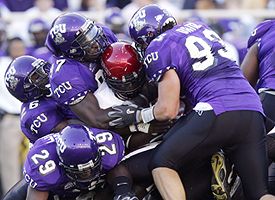 It's finally here-- the biggest game of the year, unless TCU wins, in which case the Utah game will morph into a bigger matchup.
 Dare we predict the outcome? Not unconditionally. Rather, the Wimple predicts BYU will win of TCU can't figure out how to stop the Cougars from converting 3rd-and-long plays to its their tight ends. If the Horned Frogs do that, they'll keep BYU's offense off the field-- like they've done to almost every opponent they've seen this year-- and end another NCAA-leading winning streak in Fort Worth.
Pre-game press: spotlight on Daryl Washington; BYU gets film after UNM game; ACS is where winnings streaks come to die; Mendenhall on BYU's D; CGP on BYU's D; focus on the Frogs' D; Cougs good, but imperfect; FWST Wednesday notes; Max Hall is Danny White's nephew; AP says MWC has only 2 teams in contention for a BCS bowl-- BYU and Utah; CGP's weekly presser; BYU's O meets its match in TCU's D; SpitBlood's 10 things to consider; CGP says TCU must play better to beat BYU; ESPN on TCU's D; BYU's a stiff test for TCU; MWC champ and BCS spots go through ACS; turnovers are key; LeBreton: times have changed since SWC days; Frogs ready to win on a Thursday night; beating TCU would validate Hall's record; Deseret News gameday report; Rivals' pre-game report (subscription req'd);
Sunday, September 14, 2008
MWC goes 4-0 against the Pac-10
It's a banner week for the Mountain West-- the conference's teams went 6-1 against division 1-A competition, including four wins over Pac-10 foes. BYU shut out UCLA 59-0; TCU beat Stanford 31-14; New Mexico upset Arizona 36-28; and UNLV shocked #15 Arizona State, in Tempe, 23-20 in double overtime, blocking the Sun Devils' attempt to tie the game with a field goal. (in that game, Rebels' QB Omar Clayton took a hit in the jaw so hard in the second quarter that they team x-rayed him to make sure it wasn't broken. It wasn't. Clayton returned to the game, and led UNLV to the win.)
BYU, TCU, and New Mexico each capitalized on multiple turnovers by their BCS foes.
The Mountain West is 6-3 against BCS competition this year, and 10-3 against all D-1A teams.
BYU, TCU, and New Mexico each capitalized on multiple turnovers by their BCS foes.
The Mountain West is 6-3 against BCS competition this year, and 10-3 against all D-1A teams.
Monday, April 28, 2008
Post-Spring MWC Football Round-Up: the Contenders
Although they change order from year to year, these three teams continue their choke-hold on the conference's top expectations. All three return much of their offenses. The Utes and Cougars must re-construct key pieces of their defenses. The Horned Frogs appear poised to emerge from a semi-rebuilding year with a vengeance. Utah wins the scheduling lottery, facing both TCU and BYU at home, in November.
- BYU-- The pieces are in place for an utterly devastating offense. Will the defense take form fast enough to keep the pressure off Max Hall and his offensive brethren? The Cougars' have to travel to Fort Worth and Salt Lake City, though, facing both of the MWC's other best teams on the road. Both contests look to be dandies. This could be the first year in a while nobody sweeps the conference. Jake Locker's Washington Huskies may test the Cougars' new starters at linebacker and safety passed their limits, but by the time BYU travels to Fort Worth, the squard should be solid.
- TCU-- After a tough but disappointing season, look for the Frogs to cash in some good luck for a change. They will bring an improved pass rush, power running, and QB play to the gridiron in '08, and will compete for the league title. They play in each of the first 11 weeks of the season, and will need some luck to face Utah-- in Salt Lake City on week 11-- healthy. If the Frogs can break their Thursday blues, and beat BYU and Utah (both meet the Frogs on Thursday nights), the Frogs will be an attractive one-loss invite to the Orange Bowl. Of the Frogs' opponents, only Oklahoma is more talented.
- UTAH-- This is Brian Johnson's last year with the Utes, and it may be his best. Utah's defense loses key personnel at all three levels, but likely will have the offensive firepower to give their D room to grow. Facing BYU and TCU at home is a boon. Winning the season opener at Ann Arbor will attract the national spotlight; cashing in on that attention could make Utah a favorite for an at-large BCS berth.
Monday, December 3, 2007
TCU to return to Houston for the Texas Bowl; 5 MWC Teams Go Bowling
 http://www.texasbowl.org/-- TCU will square off against the Houston Cougars in the 2007 Texas Bowl . . . This is the Horned Frogs’ third consecutive winning season and their third consecutive bowl appearance. . . TCU head coach Gary Patterson is in his seventh season at the helm and has posted a 60-25 record, including leading the Horned Frogs to a bowl game six times. Patterson has had four 10-win seasons, more then any other coach in TCU history.
The 2007 Texas Bowl will be played on Friday, December 28 at Reliant Stadium at 7:00 p.m. and the game will be televised nationally on NFL Network. DePelchin Children’s Center, Houston’s oldest charitable organization, is the official charitable partner of the Texas Bowl.
[here's the goFrogs.com release]
Five Mountain West teams will play bowl games this year- the most ever. The Mtn.'s preview of the MWC bowls.
BYU will face UCLA (again!) in Las Vegas, Air Force v. California in Fort Worth; Utah v. Navy in San Diego, TCU v. Houston in Houston, and New Mexico v. Nevada in Albequerque.
Monday, November 12, 2007
BYU 27, TCU 22
The Frogs lost another close contest, this time in Provo, falling to 1-2 against BYU since joining the Mountain West.
TCU must beat surging SDSU on the road and UNLV at home in order to attract a bowl bid.
TCU must beat surging SDSU on the road and UNLV at home in order to attract a bowl bid.
Subscribe to:
Posts (Atom)


